The Marketing Toolbox: What's Actually Behind the Curtain
Most owners think 'marketing software' is one thing. It's not. It's a tool chest with at least eight drawers, and the person doing this well knows exactly which one to open for which question. Today I'm going to open every drawer.
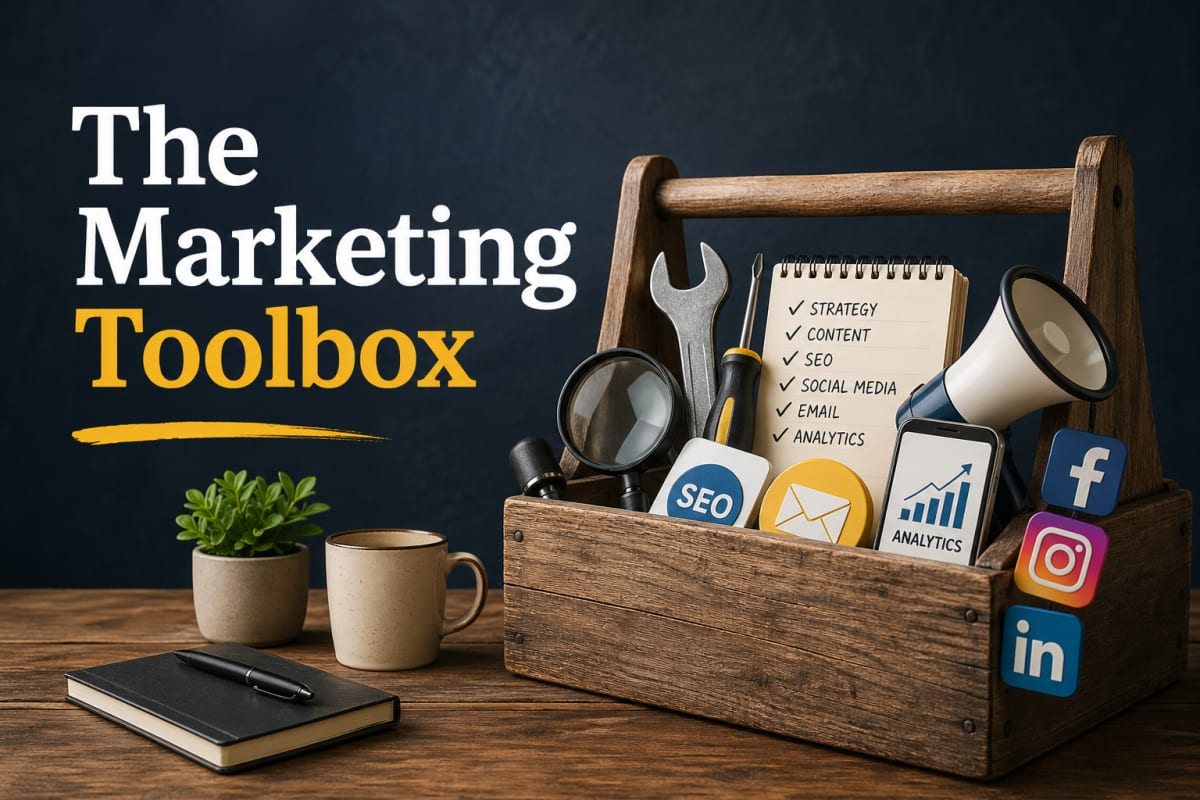
When your service truck breaks down, you don't fix it with a hammer. You don't even fix it with one wrench. You have a whole rolling tool chest, and you know exactly which drawer comes out for which job. A timing belt isn't a brake pad. A leaky valve isn't a clogged trap. You wouldn't dream of treating them the same.
Now flip it around.
When you hire a marketing agency, or when you try to do this yourself, you're walking into a shop full of tools you've probably never seen. Most owners I talk to think "marketing software" is one thing. It's not. It's a tool chest with at least eight drawers, and the person doing this well knows exactly which drawer to open for which question.
The good news: most of these tools are free. The better news: you don't have to use any of them yourself. But you do have to know what's in the box. Otherwise you can't tell if your agency is doing a good job, you can't ask the right questions when someone is pitching you, and you definitely can't make a smart bet on what to DIY.
Today I'm going to open every drawer.
Why this matters even if you never touch any of it
Here's what most owners never calculate. The gap between "marketing is a black box my agency handles" and "I know what's in the toolbox" is worth roughly 10x more in negotiating leverage than it is in DIY savings.
Three reasons to learn this even if you never log in:
- You can't grade work you can't see. When your agency sends you a monthly report, you're either trusting their summary or you're trusting nothing. Neither is great.
- You can't ask good questions on a sales call. When the next vendor calls offering "SEO services," knowing the difference between Google Search Console (free) and SEMrush ($129/month) changes the conversation entirely.
- A surprising amount of this is free, and easy. A one-truck operation can get to 80% of what a national chain does using tools that cost zero dollars, if you know they exist.
You don't have to know how to use any of this. But you do have to know it exists.
The toolbox, organized by drawer
I'm going to organize these by the question each tool answers. Not by vendor, not alphabetically. That's what makes a toolbox useful. Each drawer answers a different question.
Drawer 1: "Can people find me when they're looking?"
This is the discovery drawer. Two tools matter.
Google Business Profile (free). This is your single most important asset as a local service business. Full stop. GBP isn't your website. It's the result tile that shows up when someone searches "plumber near me," and it's where roughly 60% of local discovery now happens. Hours, photos, services, reviews, Q&A, posts. It's all here. If you do nothing else from this list, claim and complete your GBP today.
Google Search Console (free). This tool tells you what queries Google is associating with your website. Most owners have never logged in. They should. GSC will tell you that your service-area page hasn't been indexed since the redesign in March, that your pricing page is suddenly ranking for a competitor's name, or that 47% of your impressions are coming from a keyword you didn't know mattered. Translation: it's the X-ray of how Google sees you.
Drawer 2: "Where are visitors coming from, and what are they doing?"
This is the analytics drawer.
Google Analytics 4 (free). The standard. GA4 will tell you how many people visited your site, where they came from, what pages they read, and where they dropped off. The catch: GA4 is event-based, which means it confuses every owner the first time they see it. The reports are not as friendly as the old Universal Analytics. Don't worry about that. Focus on three numbers: traffic by source, top landing pages, and conversion rate.
Mixpanel (free up to 1M events, paid above). A few years ago I'd have called this overkill for a local service business. Not anymore. Three specific places it earns its keep in 2026:
- Multi-stage lead capture forms. The highest-converting service-business websites being built today don't ask for a name and phone number on one screen. They ask a sequence: What service do you need? When? Where? Then name and phone. The conversion data on a single-screen form is useless. The conversion data on a five-step form is gold. Mixpanel will tell you that 64% of visitors complete step 3 but only 22% complete step 4, which means step 4 is where you're hemorrhaging money. GA4 can do this. Mixpanel does it better, and the difference shows up in the work you do next: rewrite step 4, run an A/B test, and recover the leak.
- Agentic engagement on your website. This is the new shape of customer interaction. Plumbers, attorneys, and HVAC companies are starting to embed AI agents on their websites that can answer questions, qualify leads, and even book appointments before a human ever picks up. Mixpanel is how you measure whether the agent is actually doing its job. What questions does it answer well? Where does it fail and hand off to a human? Which conversations convert into a booked appointment, and which die in the chat window? You cannot run an agentic experience without instrumenting it, and that instrumentation is exactly what Mixpanel was built for.
- E-commerce conversions and the micro-moment. Google has a framework called "micro-moments." Translation: the small flashes of intent when a customer wants to know, wants to go, wants to do, or wants to buy. The biggest one for service businesses is the I-want-to-buy moment, and more local businesses are selling online than ever before: maintenance subscriptions, prepaid service plans, parts, scheduled tune-ups, even one-time appointments paid through Stripe at booking. Capturing that micro-moment, and not losing it, requires you to know exactly where in the buying flow people abandon. That's a Mixpanel job, not a GA4 job. If you're charging $19/month for an HVAC maintenance plan and 200 people start the checkout but only 60 finish, the difference between a $14,000/year customer base and a $46,000/year customer base is sitting in a single drop-off step you haven't measured yet.
If none of those three patterns describe your business, GA4 is still enough. If even one of them does, you're leaving money on the table by not measuring it properly.
Drawer 3: "Are people calling, and where are those calls coming from?"
This is the most-overlooked drawer in the entire toolbox.
CallRail or WhatConverts ($45 to $95/month). Here's the problem nobody talks about: when a customer calls a local service business, the call doesn't get attributed back to the source. You have no idea whether they came from your Google ad, your GBP listing, your Facebook post, or a yard sign. Call tracking software gives every channel its own phone number, or dynamically swaps the number on your website based on where the visitor came from, and routes the call to your real line while logging the source.
I'll say it plainly: the average HVAC contractor or attorney should care more about CallRail than they care about GA4. Calls are the conversion. Tracking them is the difference between knowing what your marketing actually does and guessing.
Drawer 4: "Am I getting my money's worth on ads, and what should I write about?"
This drawer does two jobs at once.
Google Ads. Yes, it runs your paid search campaigns. But the move most owners miss: Google Ads is also the single best free keyword research tool on the internet. The Keyword Planner inside Google Ads will tell you exactly what people are typing into Google in your service area, and how often. Translation: this is how you decide what blog posts to write, what landing pages to build, and what services to feature on your site. The keywords with high search volume and low competition are your roadmap for SEO content. Most agencies charge $500 to $2,000/month for this insight. Google gives it away.
Local Services Ads, also called LSAs or "Google Guarantee." A pay-per-lead version of Google Ads, only available to certain trades. If you're a plumber, electrician, HVAC, locksmith, lawyer, or roofer, you've probably seen these. They show up at the very top of search results with the green checkmark. Worth knowing exists. Worth being skeptical about: you're renting the customer relationship from Google, not building one.
Meta Ads Manager (Facebook + Instagram). Less for "find me a plumber right now" intent. Better for awareness, neighborhood targeting, and retargeting people who already visited your site. Useful in the right hands, expensive to learn yourself.
LinkedIn Ads. Only relevant for B2B services: accountants serving businesses, attorneys representing companies, commercial cleaners, IT services. If your customers are consumers, skip this drawer.
Drawer 5: "What are people saying about me?"
This is the reputation drawer, and for most local service businesses it's the most important drawer in the box besides Drawer 1.
Google reviews (managed inside GBP). The single highest-leverage review channel for almost every local trade. AI assistants explicitly use review counts and recency when deciding which businesses to recommend. ChatGPT will recommend the plumber with 247 reviews and a 4.8 rating over the one with 19 reviews and a 4.9. Volume matters now.
Yelp. Still matters in some categories: restaurants, contractors in some metros, certain professional services. Less universal than it used to be.
BirdEye ($300+/month). Review-request automation. After every job, BirdEye texts the customer and asks for a review. If they give a low rating internally, it routes them to a feedback form before going public. If they give a high rating, it pushes them straight to Google. Worth it for a 5+ van operation. Probably overkill for a one-truck.
Drawer 6: "Who's a customer, and how do I keep talking to them?"
This is the customer database drawer.
HubSpot, Mailchimp, Klaviyo, Customer.io. All variations on the same idea: a list of customers and prospects, with the ability to email them on a schedule or based on what they did. HubSpot is the heaviest. Mailchimp is the lightest. Klaviyo is built for e-commerce, Customer.io for software. For most local service businesses, Mailchimp at $13/month is plenty.
ServiceTitan, Housecall Pro, Jobber. Vertical CRMs built specifically for trades. Most owners already pay for one and don't realize it has marketing features baked in. Housecall Pro will send a "we miss you" text 11 months after the last service call. ServiceTitan can run an entire follow-up sequence based on the work order. If you're paying $300/month for one of these and not using the marketing tools, you're leaving money in the seat cushions.
Drawer 7: "The glue"
These tools don't do anything visible. They make everything else work.
Google Tag Manager (free). GTM is the box that holds every tracking pixel in one place: Google Ads, GA4, Meta, LinkedIn, CallRail, anything else. Set up properly, it lets you add or remove tracking without touching the website code. A 30-minute GTM setup is the highest-ROI thing most local business websites can do.
Zapier or Make ($20 to $50/month). Connector software. When a new lead fills out the contact form, Zapier can send the lead to your CRM, text the office, send a Slack notification, and add the lead to your email list, automatically, in about three seconds. Glue.
Claude Code or Codex ($20 to $200/month). This is the new hire you didn't know you could afford. Translation: AI coding agents that turn plain-English instructions into real, working code. Where Zapier ends, this begins. Custom landing pages built in 30 minutes. Scripts that connect two systems Zapier doesn't speak to. Schema markup written to spec for AEO. A weekly performance report pulled together overnight by an agent you talk to like an employee. The line between "marketing software" and "custom software you wrote yourself" used to be a developer who cost $150 an hour. Now it's a $20-a-month subscription and a willingness to type what you want. Most local service business owners haven't tried this yet. The ones who do this year are going to look at the ones who don't the way a contractor with a power drill looks at one with a screwdriver.
Drawer 8: The AI layer, and the missing link nobody is talking about
Here's where it gets interesting.
ChatGPT, Claude, Gemini. You've used these. You probably think of them as "the thing that writes emails for me." For marketing, they're something more.
But there's a piece almost nobody outside of tech understands yet, and it's the missing link that turns AI from a fancy chatbot into a real business intelligence engine.
That piece is called MCP, or Model Context Protocol. Translation: it's the wiring that lets an AI assistant pull live data directly out of every other drawer in this toolbox.
Watch what happens when MCP is connected.
You sit down with Claude desktop on a Monday morning. You ask: "How did our marketing perform last week?"
Claude reaches into Google Analytics 4 and pulls traffic by source. It reaches into Google Business Profile and pulls new reviews and direction requests. It reaches into Google Search Console and pulls keyword trends. It reaches into CallRail and pulls inbound call counts by source. It reaches into Google Ads and pulls cost per lead. Then it reads all of that simultaneously, in context, and tells you in plain English: "Phone calls from your GBP listing dropped 18% week-over-week, your Google Ads cost-per-call rose to $87 from $54, and three of last week's five new reviews mentioned the same thing: the technician was late. Suggested action: tighten dispatch SLAs, pause the underperforming ad group, and respond to the reviews with a public commitment."
That's not a chatbot. That's a marketing director, on demand, reading your live business data and recommending next steps.
This is the part most agencies haven't caught up to yet. The companies that figure out MCP-connected AI in 2026 will run circles around the ones still pulling screenshots into PowerPoint.
The new Monday morning
Here's the picture that pulls it all together.
The old Monday morning, for someone running this stack, looked like this: log into GBP. Log into Search Console. Pull a screenshot. Log into GA4. Build a chart. Log into CallRail. Cross-reference the calls to the ads. Log into Google Ads. Pull the spend. Open Excel. Update a slide. Email it to the owner. Three hours, every Monday, gone.
The new Monday morning looks different. The marketer opens Claude desktop. The MCPs are already connected to GA4, GBP, GSC, CallRail, Google Ads, and the CRM. The first prompt is a single sentence: "Give me last week's marketing performance, what changed, and three things we should adjust this week."
Claude reads the live data, builds the report in 90 seconds, and surfaces three concrete recommendations. The marketer reads it, picks two to act on, and moves the conversation: "Draft new ad copy for the underperforming group based on the reviews mentioning lateness." Done by 9:30. The owner has a real, current view of the business by the time they finish their first cup of coffee.
This is what running marketing looks like in 2026. Faster decisions, with better data, in a fraction of the time. The agencies and in-house teams that aren't here yet are about to fall behind very quickly.
What you can DIY in 30 minutes a week
You don't have to wait for any of this to start. Here are six things any owner can do with zero training:
- Claim and complete your Google Business Profile. Photos. Hours. Services. Q&A. Description. Posts. All of it. This single drawer is worth more than every other drawer combined for most local service businesses.
- Set up Google Search Console. One line of code or one DNS verification. Watch what happens.
- Submit your sitemap to Google through Search Console. Once GSC is connected, drop in your sitemap.xml file. It tells Google exactly which pages on your site to crawl, in what order, and how often. We've found that customers who do this see inbound organic traffic start climbing inside three weeks.
- Read your reviews. Respond to every single one. Not a template. A real reply. AI assistants are reading these too. Your reply tone is now part of how they decide whether to recommend you.
- Open Google Ads Keyword Planner and look up your top three services in your city. What you see is your content roadmap for the next year.
- Ask ChatGPT or Claude to read your last 20 reviews and tell you the top three patterns customers love. That's your positioning, in plain English, written by your own customers.
That's a real list. A real owner can do all six in a single afternoon.
What's worth paying someone for
Here's the honest line.
Conversion tracking and AEO setup. A properly done conversion tracking and Answer Engine Optimization setup (schema markup, semantic HTML, GTM, GA4 events, CallRail integration, structured data for every service page) is a $1,500 to $5,000 job that pays for itself in clarity and visibility within a quarter. AEO is the part most agencies still don't do, and it's how AI assistants decide whether to recommend you when a customer asks ChatGPT for "the best HVAC company in Tampa." If your competitors aren't doing this yet, you have a 12 to 18 month head start by getting it done now.
Ad management at scale. Anything beyond a couple hundred dollars a month in Google Ads or Meta Ads benefits from a real human running it. The wrong settings can burn through a month's budget in a weekend.
Ongoing process automation across the buyer's journey. This is the work most agencies don't even talk about, and it's where the real money is left on the table. The buyer's journey isn't just "click an ad, fill out a form, get a call." It's the text message that goes out an hour after the appointment confirming the technician's name and ETA. It's the landing page tailored to the specific service in the specific neighborhood. It's the YouTube channel that explains the most-asked question your customers have, so AI assistants can cite it when someone asks the same question six months from now. It's the post-job follow-up sequence, the seasonal campaign, the review request, the win-back text 14 months after the last service call.
This isn't a one-time job. This is an ongoing partnership, usually a monthly retainer, where someone is constantly tightening the screws on every step of how a customer finds you, hires you, pays you, and stays with you. Most owners pay nothing for this work today, and it's the highest-leverage marketing investment they're not making.
Open the box
You don't need to be a mechanic to know your truck has a transmission. You don't need to be a marketer to know your business has a Google Business Profile, a Search Console, a call tracking number, and an analytics tag.
The owners who win the next five years won't be the ones who learn every tool in this list. They'll be the ones who know the toolbox exists, know which drawer answers which question, and know who to hand the wrench to when the answer matters.
Drawer 8 is the new shape of marketing. AI plus MCP plus your own data is the difference between guessing and knowing. The companies that figure that out in 2026 are about to leave the rest of the field behind.
Open the box.