Content Marketing for Service Businesses: Our Complete Execution Playbook
Random posting doesn't work. Strategic marketing does. Learn the complete framework Fortune 500 companies use, adapted for service businesses.
Content Marketing for Service Businesses: Our Complete Execution Playbook
Build it yourself or let us run it for you
The Random Acts of Marketing Trap
Most service businesses engage in what Emily Kramer calls "Random Acts of Marketing": posting sporadic content across platforms without strategic intent. This approach wastes 5-10 hours weekly on activities that generate minimal ROI, burn money on ineffective promotions, create missed opportunities as competitors build compounding assets, and ultimately leads business owners to abandon marketing altogether.
The distinction is critical: Random marketing doesn't work. Strategic marketing does.
Your Post Isn't Just a Post
Rather than randomly posting content, successful businesses create value deliberately. This means answering three fundamental questions:
Question 1: What problems does my content actually solve?
Focus on questions keeping customers awake at 3 AM, not what you want to say, but what they genuinely need to know. For example, "5 Signs Your Water Heater Is About To Explode" solves real problems, whereas generic "Happy Monday" posts get ignored.
Question 2: Would I pay for what I'm creating?
Apply the brutal honesty test. A comprehensive "Hurricane Prep Checklist for South Florida Homeowners" with PDFs and video walkthroughs has genuine value. Generic "spring cleaning tips" copied elsewhere does not.
Question 3: Can I use this again in three months? Six months? Next year?
Distinguish between ephemeral content and lasting assets. A "Happy Tuesday" post expires within hours. A detailed guide generates leads for years. One comprehensive resource can become a blog post, ten social media posts, email newsletter content, FAQ answers, Google Business Profile updates, and more.
The Two-Part Framework
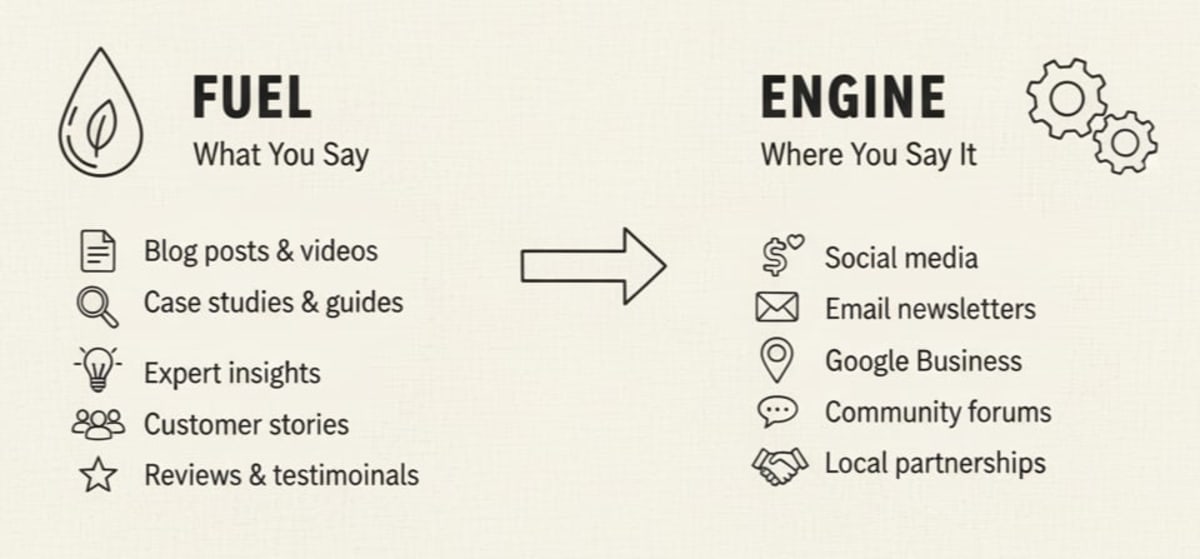
Successful marketing requires both fuel and engine working together:
Part 1: The Fuel (What You Say)
- The content you create: blogs, videos, case studies, guides
- Your expertise: stories from real projects, before/afters, solutions
- Your reputation: reviews, testimonials, community involvement
Part 2: The Engine (Where, How, When You Say It)
- Strategic channel selection matching where your actual customers congregate
- Consistent, purposeful distribution rather than everywhere simultaneously
Most businesses fail by creating excellent content but keeping it in the garage (no distribution), or posting consistently with nothing worthwhile to say (all engine, no fuel).
Finding Your Unfair Advantage
Rather than claiming generic superiority, identify what genuinely distinguishes your business. Five primary advantage types include:
The Specialist Advantage: Go narrow when competitors go wide. A contractor specializing exclusively in tankless water heater installations becomes the obvious expert.
The Community Advantage: Become woven into local fabric through genuine involvement: coaching, sponsorships, networking, creating trust that transfers to professional relationships.
The Personality Advantage: Let your authentic style shine. Some customers want hand-holding; others prefer efficiency. Authentic personality creates loyalty where competitors seem interchangeable.
The Process Advantage: Systemize something competitors wing. Same-day quote photos, 24-hour document turnaround, or real-time project updates remove customer friction.
The Proof Advantage: Accumulate overwhelming evidence through reviews, completed projects, certifications, and longevity that makes choosing you obvious.
The Planning System That Makes Content Work
Before creating anything, answer four questions:
Question 1: What's the goal? State it specifically: "Generate 3 kitchen remodel consultations over $50K" plus positioning goal: "Establish reputation as luxury remodel specialist."
Question 2: Who exactly am I talking to? Be uncomfortable specific: "45-55 year old Plantation homeowners whose kids left for college, planning downsizing within five years."
Question 3: What do they actually need to know? Not what you want saying, but questions they asked before hiring you. Your previous customer conversations are your content goldmine.
Question 4: Where will this actually reach them? Identify specific distribution channels before creating. If you can't list five places to use it, don't create it yet.
Common Mistakes to Avoid
Mistake 1: Waiting for slower periods to start. Business never slows down; start when you don't feel desperate.
Mistake 2: Creating good content then sharing it once. Distribution matters more than creation. Spend twice as long promoting as creating.
Mistake 3: Believing you need daily posting. One excellent piece monthly distributed 10+ ways beats 30 mediocre weekly posts.
Mistake 4: Trying to dominate every platform. Excellence in 2-3 places beats mediocrity everywhere.
Mistake 5: Copying competitors. Use their success to understand what works in your market, then create your authentic version.
Mistake 6: Dismissing content marketing as incompatible with your industry. Every business has customers with questions; answering them better than anyone else works universally.
Your Next Move
Random posting doesn't work. Hope isn't strategy. Competitors implementing this framework will dominate while others wonder why their Facebook posts get three likes.
You don't need a marketing degree or exceptional writing ability, just a system. The frameworks Fortune 500 companies use, adapted for service businesses, are actionable and practical.
GTM37 offers support through:
- Free AEO Audit: See what AI currently says about your business (2 minutes)
- AI-Ready Website: Built with technical SEO and schema markup optimized for both human and AI discovery
- Content Marketing Service: Interview monthly, we handle creation and distribution
Whether implementing yourself or partnering with professionals, stop posting random content and start building something that compounds.