Stop Renting Your Customers: Why Ads Are Only Half of a Marketing Strategy
If you stopped paying Google Guarantee, Angi, and Facebook Ads tomorrow, would your phone still ring? You're not doing marketing. You're renting access to customers.
Stop Renting Your Customers: Why Ads Are Only Half of a Marketing Strategy
How to Cut Ad Spend by 50% and Get More Customers
Welcome to Booked Solid, the newsletter that gives local service businesses access to the same tools and strategies used by Big Tech and Fortune 500 companies. Free weekly updates, straight to your inbox.
If you stopped paying Google Guarantee, Angi, and Facebook Ads tomorrow, would your phone still ring?
Take a second. Really think about it.
If your answer is "no" or "I'm not sure," you've got a $2,000/month problem that's about to get a whole lot worse.
Here's what nobody wants to tell you: You're not doing marketing. You're renting access to customers. And just like your apartment lease that goes up every year, your marketing "rent" is about to price you out of the market.
But here's the kicker: 700 million people now ask AI for recommendations every week. And guess what AI can't see?
Your ads.
Every. Single. One.
The $2,000/Month Hamster Wheel You Can't Escape
Let me paint you a picture that probably looks familiar.
You're spending:
- Google Guarantee: $1,000/month
- Angi or Thumbtack: $500/month (plus that sweet 15% commission)
- Facebook/Google Ads: $500/month
Total damage: $2,000/month. Every month. Forever.
What do you get? Maybe 5-8 jobs if you're lucky. And after 12 months? You've burned through $24,000 and own exactly... nothing.
Zero. Zilch. Nada.
If you stopped paying tomorrow, who would know you existed?
Meanwhile, Google Guarantee prices are up 40% in two years. Angi keeps taking bigger bites. Facebook ads? Three times more expensive than 2019.
You're not building a business. You're handing more money to the big marketplaces, whose profit margins already average 50%. You're a business owner, not a Facebook and Google's tenant.
The Renter, The Owner, and The Earner Walk Into a Bar...
This isn't a joke, but it might as well be.
Let me tell you about three contractors I know. They're all real, though I've changed their names.
Joe the Renter spends $3,000 a month on various platforms. He's got Google Guarantee, Angi, Thumbtack, Facebook ads, even tried TikTok ads (don't ask). Joe's phone rings, but he's always stressed about lead quality and cost. Last month, he calculated he's paying $160 per acquired customer. A big problem when he only makes $230 on his average job. His closing rate is dropping because customers are shopping purely on price, which makes sense, since they found him on a platform that literally shows his price next to four competitors. Joe owns nothing after five years in business except a list of platforms that own him.
Sarah the Owner took a different path. Three years ago, she was just like Joe. Then she cut her ad spend in half and invested in building assets she actually owns. She hired a local writer to create two blog posts a week answering real customer questions. Her website now has 30 pages of content about every possible HVAC issue in her city. When someone searches "why is my heat pump making a weird noise in Houston," Sarah shows up. Not an ad, her actual expertise. She still runs some ads, but they're maybe 30% of her marketing budget now. Sarah's no longer working in her business, she's working on it, expanding her operations into Orlando and Jacksonville.
Tom the Earner is playing an entirely different game. He realized early that you can't buy trust; you have to earn it. Tom has 127 Google reviews (the next competitor has 31). He's answered over 200 questions on Nextdoor. He sponsors his kid's little league team and coaches on weekends. When someone in his community needs an electrician, Tom isn't just an option, he's THE option. His marketing budget? Almost nothing. His waiting list? Three weeks out.
Here's what's fascinating: All three contractors do good work. All three charge similar prices. But only Sarah and Tom will still have businesses in five years.
The Shift Nobody's Talking About (But You're Already Living)
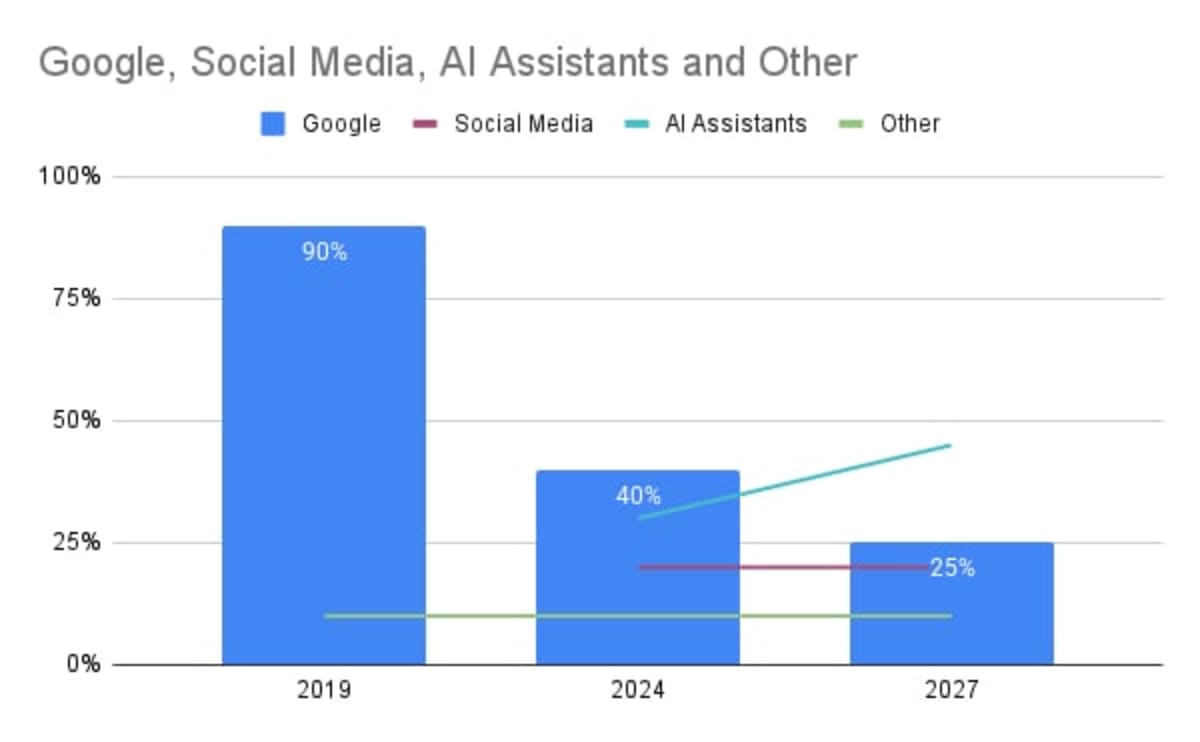
We need to talk about what's actually happening to your marketing dollars, and it's not pretty. In 2019, life was simple. Nine out of ten customers started their search for a service provider on Google. You bought Google ads, you got calls. Done.
Fast forward to today, and the landscape looks completely different. Only 40% of searches start on Google now. Another 30% of people skip Google entirely and ask AI assistants like ChatGPT, Claude, or Gemini. Twenty percent go straight to social media for recommendations. The remaining 10% use various other sources.
By 2027, these numbers get even more dramatic. Google drops to just 25% of searches. AI jumps to 45%. Social media holds steady at 20%.
Think about what this means for your ad spend. Your Google Ads are completely invisible to that 30% using AI. Your Angi profile? AI doesn't even know it exists. That Facebook campaign might reach the social media crowd, but only if the algorithm decides to show it, and only if you keep paying.
You're paying more money to reach fewer people. It's like advertising in the Yellow Pages while everyone's using smartphones.
Actually, it's worse. At least the Yellow Pages didn't raise prices 20% every year.
Let's Do Some Painful Math
I know, I know. Nobody likes math. But this is the kind of math that'll save your business.
Let's use our HVAC contractor friend from earlier. She's currently spending $2,000 a month on marketing, generating about 12 jobs, which means she's paying roughly $166 per job just in marketing costs. After a full year, she's spent $24,000 and owns absolutely nothing. If she stops paying, her phone stops ringing.
Now, let's look at what happens with the same $2,000 monthly budget but a different strategy.
For the first three months, she keeps 50% of her ads running: that's $1,000 a month to maintain cash flow while building. She invests $1,500 once in a professional website that actually answers customer questions instead of just saying "Call for a free quote!" She spends $350 monthly on content creation: that's roughly three solid pieces a month from someone who understands her industry, and those three pieces get recycled across multiple social media platforms, increasing her reach without increasing expense. The remaining $150 goes to basic SEO setup and maintenance.
Months four through twelve look different. She's cut ads down to just $800 monthly, only keeping the ones that actually convert. She's kept her content and SEO investment to $500 monthly because it's working. She's spending $200 on community engagement: sponsoring local events, joining business groups, actually showing up where her customers are.
Here's the beautiful part: She's saving $500 every single month. That's $6,000 a year she can reinvest, or heaven forbid, actually keep.
After twelve months, she owns 50+ pieces of content that will work forever, has earned 30+ new reviews that build permanent trust, ranks in the top three for her main services without paying per click, and (this is the big one) AI knows who she is and recommends her.
Same money. Completely different outcome. One builds dependency, the other builds equity. We invest in retirement accounts because of the compounding power of interest over time. This is exactly the same concept.
The Four-Phase Escape Plan
Phase 1: Stop the Bleeding (Month 1-2)
First, figure out what's actually working. Track every lead source for two weeks. I bet you'll find one platform eating 40% of budget while delivering 10% of jobs.
Cut it. Today.
Not tomorrow. Not next month. Today.
Take that money and:
- Build a website that actually answers customer questions
- Fix your Google Business Profile (it's probably a disaster)
- Create a simple review request system
Phase 2: Build While You Buy (Month 3-6)
Keep your best performing ad platform at 70% spend. Use the other 30% to build what you'll actually own.
Every week:
- Answer one real customer question in detail
- Post it on your website
- Share it everywhere
- Ask two customers for reviews
That's it. One question. Two reviews. Every week.
Phase 3: The Flip (Month 6-12)
This is where it gets fun.
Your content starts ranking. Reviews hit critical mass. AI begins noticing you exist.
Now you can:
- Cut paid platforms to 50% of original
- Watch organic leads increase
- See your name in AI recommendations
- Actually sleep at night
Phase 4: Marketing Independence (Year 2+)
You're generating 60%+ of leads from owned and earned sources.
Paid ads? Only for surge capacity.
Price shopping? Not your customers anymore.
AI recommendations? You're the default choice.
Why AI Changes Everything (And Why You Should Care)
Let's talk about the elephant in the room: AI. Not the scary "robots taking our jobs" AI, but the "your next customer is asking ChatGPT for recommendations" AI.
When someone asks an AI assistant for a service provider, it's not randomly picking names from a hat. It's evaluating signals of expertise and trust. Think of AI like the world's most thorough reference checker. It's checking references before the customer even knows your name.
AI looks for five key things when making recommendations. First, content depth: do you actually demonstrate knowledge about your trade, or is your entire web presence "call for quote"? Second, review authority: not just the star rating, but the volume, recency, and authenticity of reviews. Third, consistency: is your business information the same everywhere, or do you have three different phone numbers floating around the internet?
Fourth, expertise signals: have you published anything that shows you know what you're talking about? And fifth, trust markers: are your licenses visible, your certifications current, your guarantees clear?
Notice what's not on that list? How much you spend on advertising. You literally cannot buy your way into AI recommendations. You have to earn it through demonstrating expertise and building trust.
Every day you wait to start building these signals, your competitors who get it are pulling further ahead. And once AI learns to trust them instead of you, changing its mind is like trying to convince your mother-in-law you're good enough for her daughter. Possible, but painful.
Still not convinced you need to make this shift? Take our free AEO audit to see what AI actually says about your business right now. Fair warning: The truth might sting.
The Review Revolution Everyone Missed
We need to have a serious conversation about reviews, because most contractors are treating them like an afterthought when they should be the foundation of your marketing strategy.
Here's what blows my mind: Everyone knows reviews matter, yet the average contractor has twelve reviews from 2019, three of which are from his cousin. Meanwhile, reviews are the single highest-converting marketing asset you can build. They work 24/7, they never ask for a raise, and they get more powerful over time, not less.
The data is actually staggering. Eighty-eight percent of people trust online reviews as much as personal recommendations from friends. AI weights reviews as one of the primary trust signals when making recommendations. Once you hit 40+ reviews, your conversion rate literally doubles compared to having fewer than 10.
But here's the real kicker: reviews compound. Good reviews make it easier to get more good reviews. Lots of reviews make people more likely to leave reviews. It's a beautiful flywheel that builds on itself.
So why doesn't everyone have 100+ reviews? Because they don't have a system. They ask occasionally, when they remember, if the customer seems happy, and if it's not too awkward. That's not a system, that's a hope.
Here's an actual system: After every single job, within 48 hours, text the customer a direct link to leave a review. Not "Google us," not "leave a review when you have time," but a direct link that takes them straight to the review form. Make it so easy that NOT leaving a review is harder than leaving one.
Your goal should be 2-3 new reviews every single month. That's 24-36 reviews per year. In two years, you have 50-75 reviews. In three years, you're over 100. At that point, you're virtually competitor-proof.
The Real Cost of Doing Nothing
Let's have an uncomfortable conversation about what happens if you keep renting instead of owning. I'm not trying to scare you, but... actually, yes I am. You should be scared.
Platform prices aren't going down. They've never gone down. They will never go down. Google Guarantee will be more expensive next year than this year. Angi will take a bigger commission. Facebook will charge more to reach fewer people. This is not speculation, this is their business model.
Meanwhile, customer behavior is shifting faster than most contractors realize. Every month, more people skip Google entirely and go straight to AI for recommendations. Every month, your ads reach a smaller percentage of your total market. You're paying more to reach fewer people who are increasingly trained to shop on price alone.
But here's what really worries me: the window to build authority is closing. Right now, you can still build a content library that ranks. You can still accumulate reviews that matter. You can still train AI to recognize you as an expert. But in 12-18 months, the contractors who started now will have such a massive head start that catching up will be nearly impossible.
Think about it like this: If your competitor has 100 reviews and you have 10, how long will it take you to catch up if you both get reviews at the same rate? Forever. That's how long. The first-mover advantage in building owned and earned media isn't just significant, it's potentially permanent.
We're offering a FREE 90-Day Marketing Transformation Plan, customized to your business along with a FREE AI Visibility Audit for a limited time, whether you use our services or not.
The Binary Choice You're Facing
Let me be crystal clear about your options.
Option A: Keep Renting
- Pay more every year for less
- Stay invisible to AI forever
- Fight on price with everyone
- Hope platforms don't raise rates (they will)
- Retire broke
Option B: Build Your Empire
- Own your marketing assets
- Compound trust monthly
- Become the obvious choice
- Let platforms fight for scraps
- Build something sellable
This isn't about abandoning ads completely. It's about not betting your entire business on platforms that see you as an ATM.
Thanks for reading Booked Solid! If this opened your eyes, forward it to another contractor who's tired of feeding the platform monster. They'll thank you later.