Your Marketing Reports Are Lying to You (And What to Measure Instead)
Your monthly marketing report just landed. Impressions up 23%. Clicks up 15%. So why doesn't your bank account agree? The numbers you're looking at were never designed to measure what matters.

Your Marketing Reports Are Lying to You (And What to Measure Instead)
Your monthly report is green across the board. Your bank account tells a different story.
Your monthly marketing report just landed. Impressions up 23%. Clicks up 15%. Reach expanded to 8,000 people. Your agency is thrilled. The dashboard is green across the board.
So why doesn't your bank account agree?
That disconnect between your marketing report and your actual revenue isn't a coincidence. It's not a timing issue. And it's not because "marketing takes time to work." It's because the numbers you're looking at were never designed to measure what matters to your business. They were designed to justify more spending.
Fortune 500 companies figured this out years ago. They draw a hard line between what they call "vanity metrics" and "accountability metrics." Vanity metrics are the numbers that make reports look good. Accountability metrics are the numbers that make businesses run. Your agency is almost certainly giving you vanity metrics. And if you don't know the difference, every dollar you spend on marketing is a gamble you can't evaluate.
Five Numbers That Are Lying to Your Face
Let's walk through the metrics you probably see every month and talk about what they actually mean.
Impressions. "Your ad was displayed 12,000 times this month." Sounds great. But "displayed" means it loaded on a screen. It doesn't mean a single human being looked at it. Your ad could have loaded at the bottom of a page nobody scrolled to. It could have appeared for 0.4 seconds while someone was swiping through their feed looking for their cousin's baby photos. A billboard on I-95 has "impressions" too. That doesn't mean anyone read it while doing 75.
Reach. "You reached 8,000 people this month." Translation: 8,000 people theoretically could have seen your content. "Reach" is a measurement of potential, not attention. It counts the person who scrolled past your post in a third of a second exactly the same as the homeowner who stopped, read every word, and thought "I need to call these guys." Those are not the same thing. Not even close.
Clicks. "You got 200 clicks on your campaign." But how many were accidental thumb-taps on a phone screen? How many were bots? How many people clicked, saw your homepage that says nothing except "Call for a free quote," and hit the back button in four seconds? A click is the very beginning of a conversation. Your report treats it like the end of one.
Platform "leads." Angi says they sent you 30 leads this month. What they don't mention is that those same 30 people were sent to three other contractors at the same time. A "lead" that's simultaneously shopping four providers on price isn't really your lead. It's a shared commodity. And the platform is charging all four of you for the privilege of competing over the same person.
Engagement rate. "Your post got 45 likes and 12 comments." Great. How many of those people need a plumber? How many of them live in your service area? How many of them will ever spend a dollar with you? Likes feel good. Comments feel productive. But likes don't pay invoices, and comments don't book jobs.
Every one of these metrics shares the same fundamental flaw: they measure activity, not outcomes. They tell you something happened. They can't tell you whether it mattered.
Why Your Agency Keeps Sending These Numbers
This isn't a hit piece on marketing agencies. Most of them aren't trying to deceive you. The problem is structural.
Vanity metrics are easy to collect. Every ad platform generates them automatically. They always go up when you spend more money, which creates a comfortable cycle: spend more, watch the numbers climb, use the climbing numbers to justify spending more. It's a flywheel. Just not one that benefits you.
Here's the pattern worth understanding. In the television era, the advertising industry ran on something called GRPs, or Gross Rating Points. GRPs measured "potential eyeballs." Brands spent millions on TV commercials, measured how many people theoretically could have seen them, and for decades, nobody could actually prove any of it worked. The math looked great. The reports were beautiful. And the entire system was built on an assumption that "potential exposure" equals "actual impact."
Fortune 500 companies eventually got tired of this. They demanded real measurement. They built attribution models, incrementality tests, and closed-loop reporting that connected marketing spend to actual revenue. It took them years and millions of dollars to get there, but the principle was simple: stop measuring what might have happened and start measuring what actually happened.
The impressions, reach, and click reports your agency sends you every month are the local business version of GRPs. They measure potential. They don't measure reality. And the bigger problem? They're about to get dramatically less reliable.
This Problem Is About to Get Exponentially Worse
Over the past few weeks, something shifted in the technology landscape that most local business owners haven't noticed yet. But it's going to change the math on every marketing report you receive.
Anthropic launched full computer control in Claude Cowork. Their AI can now open applications, navigate browsers, click through websites, fill out forms, and complete multi-step tasks on a user's actual desktop. A homeowner can tell Claude, "Find me a reliable HVAC company in Fort Lauderdale and check their reviews," and the AI doesn't just search. It opens a browser, visits websites, reads review pages, compares credentials, and comes back with a recommendation.
OpenAI is merging ChatGPT, its Codex platform, and its Atlas browser into a single desktop application that handles research, analysis, and task execution autonomously. One unified system that can take a simple instruction like "I need my AC serviced, find someone good" and execute the entire research process without the user touching a keyboard.
Perplexity launched what they call "Computer," a system that coordinates 19 different AI models to break complex objectives into subtasks and execute them. Need a contractor? Perplexity's system can decompose that into: find options, evaluate reviews, check credentials, compare pricing, and present recommendations. All without the user visiting a single website themselves.
And then there's OpenClaw. If you haven't heard of it yet, you will. OpenClaw is an open-source AI agent that hit 318,000 GitHub stars in 60 days, making it one of the fastest-growing open-source projects in history. Jensen Huang, the CEO of NVIDIA, called it "the operating system for personal AI." What makes OpenClaw different from the others is accessibility. It's free. It runs on your own computer. And it works through the messaging apps people already use, like WhatsApp and Telegram. You text it a request the same way you'd text a friend. "Hey, find me a good electrician near me and check if they have solid reviews." And it goes to work. It opens browsers, visits your website, reads your Google reviews, checks your competitors, and reports back.
Here's what all of this means for your marketing reports.
Every one of these agents browses websites. They load pages. They click through content. They trigger your analytics tracking. But they are not customers. They are scouts doing research on behalf of a customer who may never visit your website directly.
Your impression counts are about to include AI agents that will never pick up a phone. Your click counts are about to include automated research bots evaluating you on behalf of a homeowner who may or may not ever contact you. And here's where it really breaks down: three or four of these agents might evaluate your business simultaneously for the same customer. One person says "find me a plumber," and Claude, ChatGPT, Perplexity, and OpenClaw each independently crawl your site, your reviews, and your competitors. Your "traffic" triples overnight. Your revenue stays exactly the same.
The vanity metrics that are already unreliable are about to become exponentially noisier. At a scale that makes today's measurement problems look quaint by comparison.
The Four Numbers That Actually Run Your Business
So what should you measure instead? Fortune 500 companies have entire analytics departments answering this question. But for a local service business, you don't need a department. You need four numbers.
Number one: How many new customers did I get this month? Not leads. Not clicks. Not form submissions. Actual human beings who paid you money for a completed service. This is the only number that can't lie to you.
Number two: Where did each one come from? Google Ads? A referral from an existing customer? AI recommendation? Nextdoor? The yard sign in someone's front lawn? You need a system for tracking this, and "How did you hear about us?" asked at every single intake is the simplest version that works.
Number three: What did each one cost me to acquire? Take your total spend on a channel and divide it by the number of actual customers that channel delivered. Not cost per click. Not cost per lead. Cost per customer. Let's run the math on a real scenario. $2,000 a month in Google Ads. 200 clicks. 30 calls. 8 booked jobs. That's $250 per acquired customer from paid ads. Now look at the 6 customers who came from referrals this month. Marketing cost: $0. Same month, two very different numbers.
Number four: What is each one worth over time? This is the one almost nobody tracks, and it changes everything. A customer who books one drain cleaning for $200 and never calls again is worth $200. The customer who books the drain cleaning, calls back six months later for a water heater install, then refers their neighbor? That customer might be worth $2,800 over three years. And here's what the data consistently shows: referral customers and customers who found you through AI recommendations rebook at significantly higher rates and spend more per job over their lifetime than customers sourced from price-comparison platforms. When you track lifetime value by source, you stop asking "which channel gets me the most leads?" and start asking "which channel gets me the best customers?" Those are very different questions with very different answers.
The Question That Replaces Your Marketing Report
If transactions are the only honest metric left, and agent traffic is about to make everything else unreliable, the question you should be asking yourself changes entirely. It's no longer "how many people saw my ad?" It's two questions: How do I become the business AI is most likely to recommend? And how do I become the easiest business to transact with?
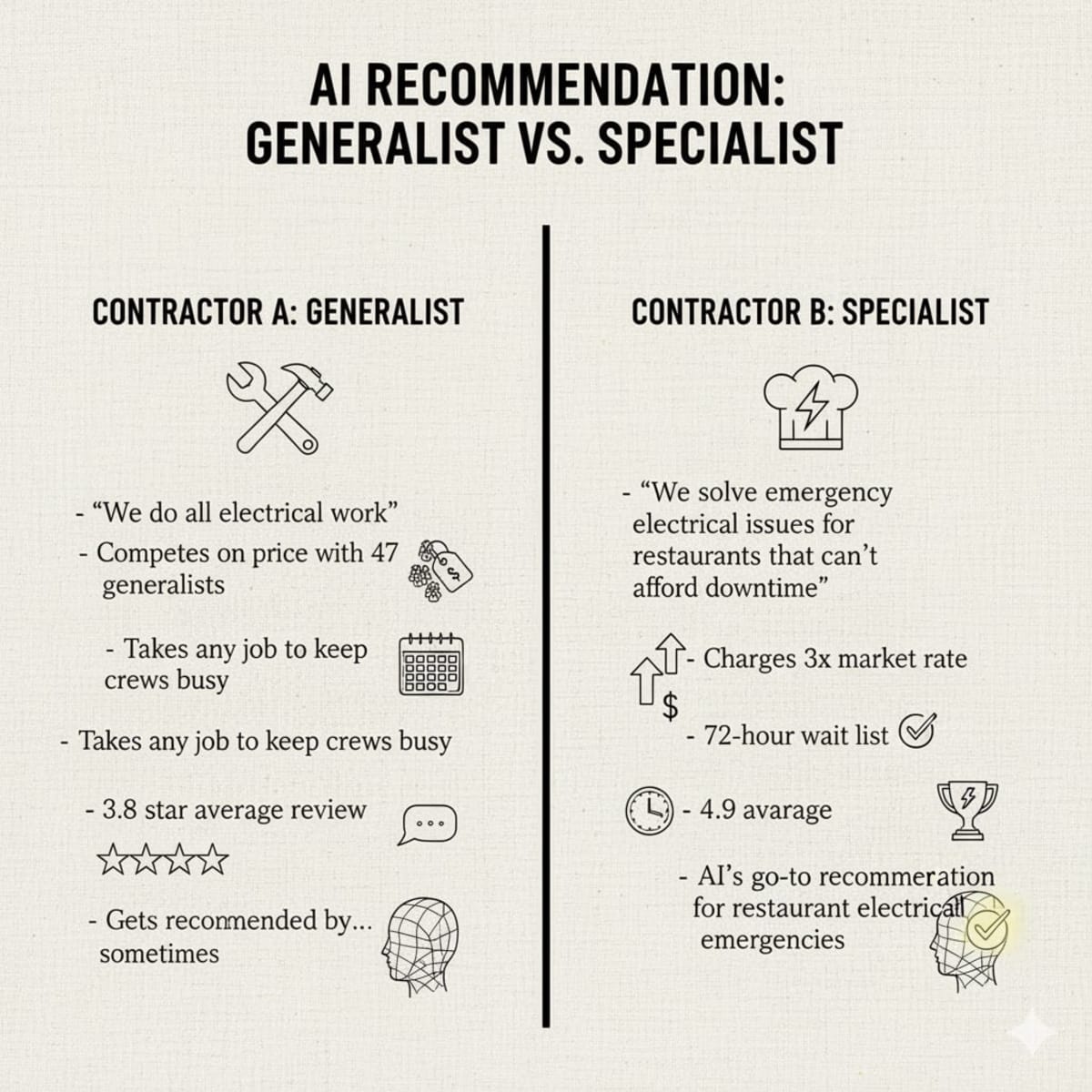
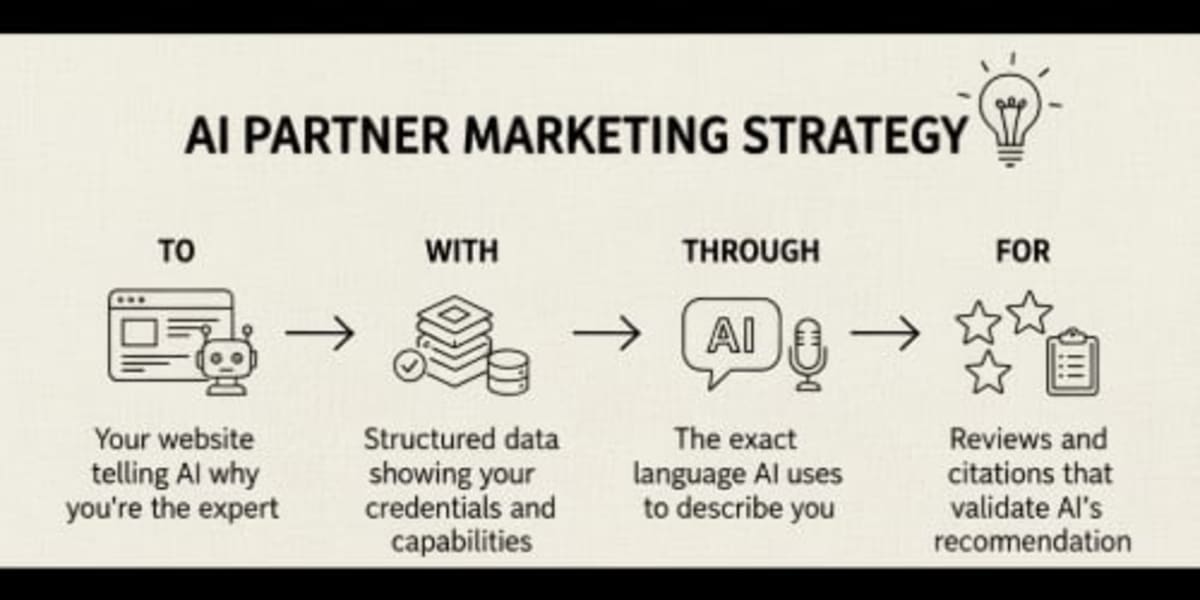
The answer to the first question won't show up in any marketing report your agency sends. It's the strength of your digital presence as a source of truth. And this is where something interesting happens. The traditional technical SEO signals that have been around for years, things like clean site architecture, structured data markup, comprehensive service pages, and properly organized content, are becoming more valuable now than they've been in a decade. Not just because Google's algorithm still rewards them, but because AI systems use those exact same signals to evaluate whether you're a credible, trustworthy business worth recommending.
A website with detailed, honest content about your services, your service area, your credentials, and your customer outcomes gives AI something to work with. It gives the agent crawling your site on behalf of a homeowner a reason to say "this one looks solid." A homepage that says nothing except "Licensed and insured. Call for a free quote." gives it nothing. And when AI has nothing to work with, it recommends someone else.
The answer to the second question is operational. When an agent or a human is ready to book, how frictionless is that path? Can they schedule online? Is your phone answered by a person? Is your Google Business Profile complete, accurate, and current? These aren't marketing metrics in the traditional sense. They're business fundamentals. But they matter more to your bottom line than every impression report you've ever received.
Here's the irony that most marketing reports will never capture: tracking softer signals like your content depth, your schema coverage, your citation rate across AI platforms, and your review velocity may deliver a larger return than obsessing over Meta pixels or Google display ad impressions. It's harder to put an exact number on "AI recommends my business in 4 out of 5 queries for my category." But that signal is worth more than 50,000 impressions that nobody, human or agent, ever acted on.
The Reports You're Getting Were Built for a World That's Already Gone
The marketing reports landing in your inbox every month were designed for a simpler time. A time when humans did their own searching, visited websites themselves, and your analytics could reliably tell you what happened. That time is ending.
The numbers on those reports are about to get louder and mean even less. More impressions. More clicks. More "reach." All increasingly generated by AI agents that will never hire you, never pay you, and never refer you to their neighbor. The signal-to-noise ratio is collapsing.
The businesses that win over the next 12 to 18 months won't be the ones with the prettiest dashboards or the most impressive-looking reports. They'll be the ones who can answer a simple question: how many people paid me this month, and why did they choose me?
If you can answer that question with confidence, you know more about your marketing than most businesses ten times your size. If you can't, it doesn't matter how green your dashboard is.
Want to see what AI actually says about your business right now? Take our free AI Visibility Audit. It takes less than two minutes, and unlike your marketing report, it won't sugarcoat the answer.