Customer Success: Revenue Multiplying Lessons from the Fortune 500
Customer Success means ensuring the right people achieve their desired outcomes through your service. When you get it right, you stop needing to market. Your customers do it for you.
Customer Success: Revenue Multiplying Lessons from the Fortune 500
Turning Every Customer Into Your Best Marketer
Welcome to Booked Solid, the newsletter that gives local service businesses access to the same tools and strategies used by Big Tech and Fortune 500 companies. Free weekly updates, straight to your inbox.
Let's start with something that should be obvious but, in my experience, often isn't.
"Customer Success" is two words. Two simple words that most businesses think they understand. But when you break them down, everything changes.
Customer: Someone who buys from you.
While true, it doesn't tell the whole story. "Buying" describes a transaction, but it does little to explain the "why" behind the "buy". So let's improve upon that definition a bit.
A customer is someone whose problem you're uniquely positioned to solve. There's a universe of difference between "anyone who pays" and "someone you're built to serve."
Success: The job got done.
Sort of…but this also falls short. Success is when your customer achieves the outcome they hired you to achieve. Not what YOU think they hired you for. What THEY think they hired you for.
Put them together and Customer Success means: Ensuring the right people achieve their desired outcomes through your service.
Customer Success is the intentional practice of making sure you're solving the right problems, for the right people, in ways that create compound value for everyone.
Call it whatever you want - some businesses say "client fulfillment," others say "service delivery," and yes, many just call it "customer service." The label doesn't matter. What matters is understanding this truth:
When you get Customer Success right, you stop needing to market. Your customers do it for you. A good customer makes you money, brings their friends, and leaves great reviews. A bad customer drains your wallet and your sanity.
Fortune 500 companies figured this out decades ago. They realized that acquiring a customer is just the beginning. The real value - the compound returns, the competitive moat, the enterprise value - comes from what happens AFTER the sale.
And in 2025, when AI reads every review, tracks every complaint, and remembers every interaction forever, Customer Success isn't just nice to have…it's your competitive moat.
The $47,000 Lesson Hidden in Your Customer List
Let me tell you about Tony, who runs a landscaping business outside of San Diego. Last year, he celebrated hitting $900K in revenue. This year, he's trying to figure out why he's barely breaking even despite being "busier than ever."
Tony's problem? He believed what most businesses believe: "All revenue is good revenue. A paying customer is a good customer. Grow now, optimize later."
Here's what Tony never calculated:
Every Thursday, Tony's crew drives 31 miles out to Mrs. Henderson's property. Round trip, that's 62 miles and 90 minutes of windshield time. She pays $75 for her weekly lawn service, which sounds decent until you realize she calls with complaints three times a month, insists on Tony's senior crew leader (not the junior guys), and changed her service date 14 times last year.
When Tony finally did the math, he nearly fell out of his chair. Between the gas ($15), drive time (90 minutes at $25/hour = $37.50), actual service time (30 minutes at $12.50), and the hidden killer - two hours monthly dealing with her complaints and schedule changes (another $20 per visit) - he was spending $85 to collect $75.
He was paying $10 every week for the privilege of mowing Mrs. Henderson's lawn.
Annual loss: $520. Plus the $50 Groupon deal that brought her in. Plus the opportunity cost of his best crew being stuck in traffic instead of serving profitable customers. Oh, and she left him a 3-star review: "They do okay work but seem rushed."
Meanwhile, Mr. Rodriguez, just down the street from his shop, was paying him enough to cover payroll, telling friends, and making Tony look like a hero. One customer was bleeding him dry. Another was worth $47,000. Which one would you rather have ten of?
But here's where it gets interesting. Mr. Rodriguez has referred four neighbors, all at full price. That's another $18,720 in annual profit from those referrals. His 5-star review ("Reliable, professional, worth every penny") has been read by hundreds of potential customers and every AI assistant in San Diego.
The difference between Mrs. Henderson and Mr. Rodriguez isn't the $50 price gap in their service. When you factor in retention, referrals, and opportunity cost over five years, it's $47,000.
One customer costs you money. The other funds your kid's college tuition!
You're not alone
It's not just service businesses that fall prey to this. I've recently worked with the founder of a software company who didn't spend the time to understand what made a "best-fit" customer and thought any dollar that came in was a good dollar. Now he's stuck with mountains of custom work, reputation damage, and a stack of unpaid invoices from an unhappy customer. And all along, his "best-fit" customers weren't getting the attention they deserved and product enhancements sat dying on the vine.
The "All Revenue Is Good Revenue" Trap
Here's what most businesses tell themselves:
- "I need the volume to keep my crews busy"
- "Some money is better than no money"
- "Once I get bigger, I'll be pickier"
- "I can't afford to turn away work"
Here's the reality: You can't afford NOT to turn away bad work.
Tech companies and investment bankers learned this the hard way. They call it the "growth at all costs" fallacy. Grab market share now, figure out profitability later. You know what happened to most of them? They went out of business with millions in revenue and zero in profit.
The math is simple but brutal.
When you take unprofitable customers:
- You subsidize bad customers with good customers' money
- You exhaust your team on unfulfilling work that loses money
- Your best employees get burned out and leave
- You have no time to serve profitable customers better
- Your good customers leave for someone who values them
- You're left with only the unprofitable customers
- You raise prices desperately
- The rest of your employees are overwhelmed and leave
- The unprofitable customers leave too
- Game over
Financial Analysts, Venture Capital and Private Equity firms call this "The Death Spiral".
Avoiding The Death Spiral
So, how do we avoid the death spiral? It turns out, It's pretty simple.
- We define a narrowly focused offering where we can deliver world class service
- We know exactly who we're solving the problem for and get in front of them
- We pay know our unit economics to find customers and deliver the service
- We intentionally architect the customer experience
- We stay disciplined
Sharp Problems
In Silicon Valley, they call it "Jobs to be Done." The consulting firm McKinsey calls it "problem-solution fit."
I call it the Sharp Problem Principle: The sharper you define the problem you solve, the more valuable you become.
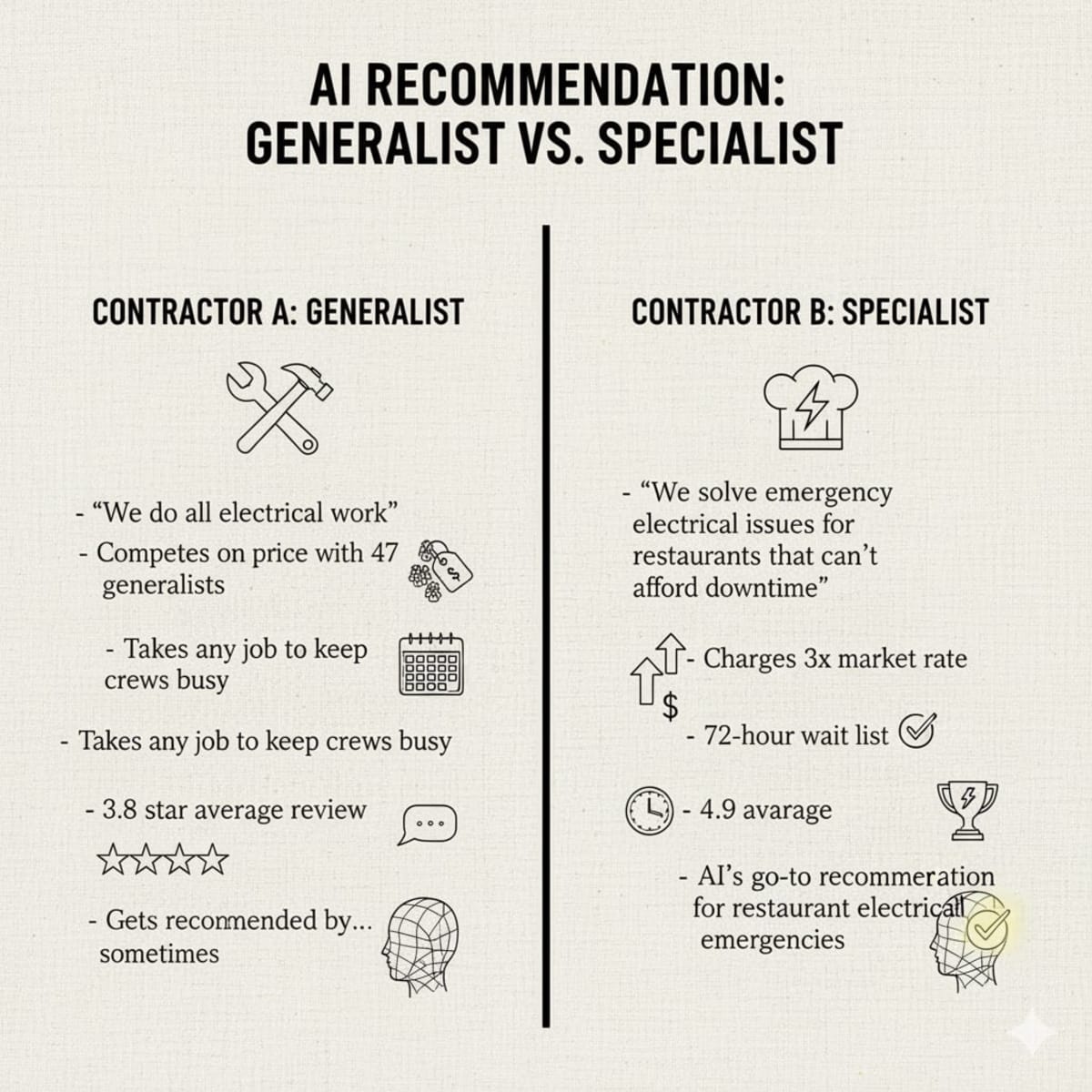
Consider two electrical contractors:
Contractor B isn't better at electrical work. They're better at Customer Success because they know exactly:
- WHO they serve (restaurants)
- WHAT problem they solve (emergency electrical preventing downtime)
- WHY they're worth the premium (speed + specialization)
The 2 metrics that matter:
Every new customer has two numbers: what they cost you to get, and what they're worth over time. Big companies call these CAC and CLV.
- Customer Acquisition Cost (CAC): What you spend to get a customer
- Customer Lifetime Value (CLV): What they're worth over time
Big business and investment firms obsess over two metrics and the ratios between them as a HUGE predictor of successful businesses.
You don't need the acronyms or the ratios. Just remember this: if a customer doesn't bring in at least 3x what you spent to win them, you're likely losing money after you cover your sales and marketing expenses, payroll, your cost to provide your service, and other administrative expenses.
The Best-Fit Customer Framework
Most service businesses think demographics define their ideal customer. "Homeowners, 35-65, household income $75K+"
That's not a customer profile. That's a census report.
Here's the framework Fortune 500 companies actually use:
The Four Filters of Fit
The brutal truth: When a customer fails even one filter, your chance of a 5-star review drops by 64%. Fail two filters? You're almost guaranteed a detractor who'll tell the world all about it. And when they tell the world about it, they're also telling your best referral partner: AI…sinking your marketing ship in the process.
The Intentional Experience Design Playbook
Bad experiences come from misaligned expectations. Period.
That 1-star review that says "They did the work but..." isn't about your service quality. It's about the gap between what the customer expected and what they experienced.
Here's how to engineer consistently great experiences:
The Three Moments That Matter Most
Moment 1: The Commitment Point
This isn't when they sign. It's when they psychologically commit to choosing you.
What most do: Send a generic confirmation email
What creates success: Send a video walkthrough of exactly what will happen, when, and why
Moment 2: The Moment of Truth
The first 30 seconds of actual service delivery.
What most do: Show up and start working
What creates success: A ritualized beginning that signals professionalism (think: pilot pre-flight announcement)
Moment 3: The Validation Point
When they evaluate if they made the right choice.
What most do: Ask "Everything looks good?" as they pack up
What creates success: Documented before/after with explanation of value delivered
The Digital Reputation Compound Effect
Here's what's different about customer success in 2025:
Every interaction creates a permanent digital record that AI reads, analyzes, and uses to make recommendations. Your customer success isn't just about today's customer - it's about every future customer AI will ever send you.
One 5-star review:
- Seen by 89 potential customers on average
- Increases AI recommendation probability by 12%
- Worth approximately $1,400 in avoided advertising costs
One 1-star review:
- Requires 7 five-star reviews to mathematically offset
- Decreases AI recommendation probability by 31%
- Costs approximately $4,200 in lost opportunity + reputation repair
The math is brutal: It's 3x more expensive to recover from bad customer success than to invest in good customer success from the start.
The AI Memory Effect
Unlike humans, AI never forgets. That angry review from 2019? AI still reads it. That unresolved BBB complaint? It's part of your permanent record.
But here's the opportunity: AI also rewards consistency over time. Businesses with consistent 4.5+ ratings across 24+ months get recommended 3.7x more often than businesses with sporadic higher ratings.
Translation: Steady good experiences beat occasional great ones.
Creating Alignment with Your "Best in Market Experience" and "Best-Fit" Customer
The hardest part isn't making customers happy. It's having the discipline to choose the right customers, set clear expectations, and deliver an experience they rave about. The most successful service businesses don't serve everyone. They serve the right ones so well, customers do their marketing for them.
The most successful service businesses aren't successful because they serve everyone well. They're successful because they serve the right customers exceptionally.
Ready to help your best-fit customers find you? Get your free AI Search Assessment and see how your digital reputation looks to the referral partner that never sleeps - AI.
Thanks for reading Booked Solid! Subscribe for free to receive new posts and support my work.
Next Week: Strategies for marketing in 2025: Key insights from our experience at INBOUND.