OpenAI Launched a Self-Serve Ad Network on the Same Day It Started Linking Every Brand It Mentions
Same day, same platform. One move sends free traffic to brands ChatGPT already recommends. The other lets brands pay to show up in conversations where they aren't recommended yet. That is not a scheduling coincidence. That is architecture.
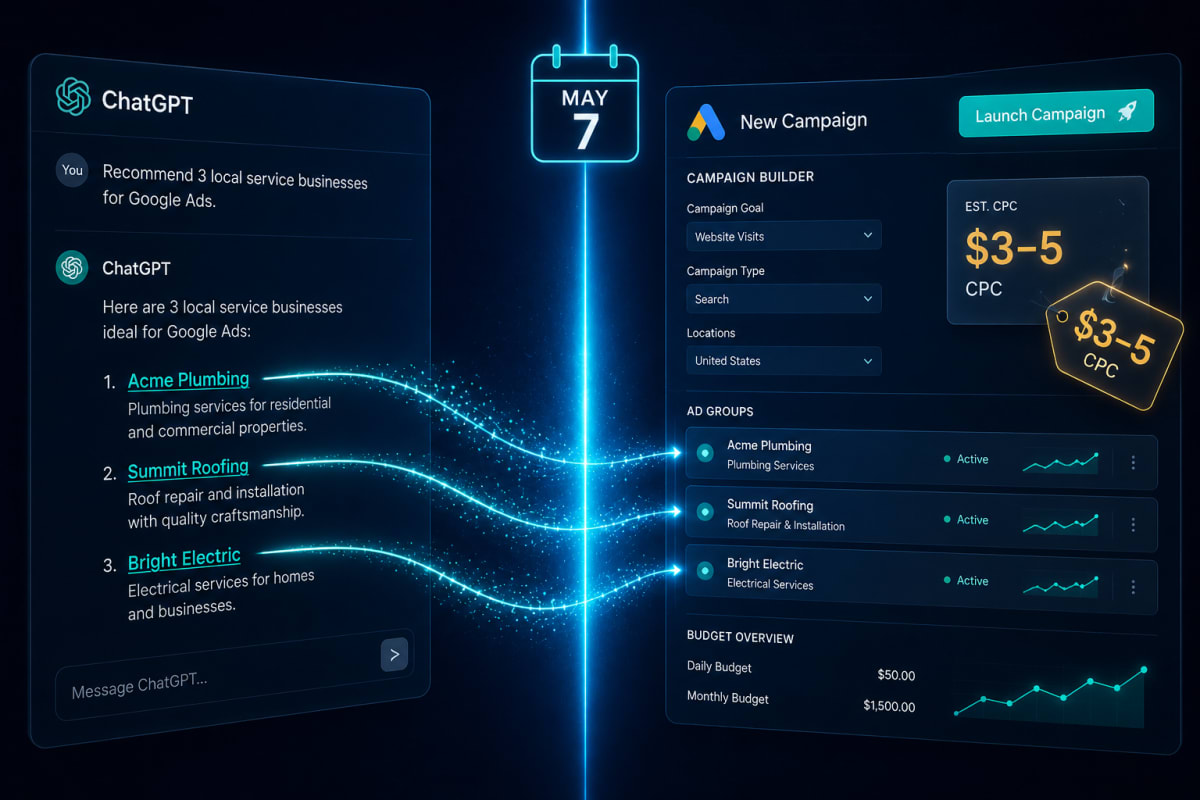
On May 7th, two things happened at OpenAI. Neither one got the attention it deserved. Together, they change the math on how your business gets found.
First, OpenAI flipped a switch that started hyperlinking brand names directly inside ChatGPT answers. Not citations buried at the bottom. Not "learn more" footnotes. Clickable brand URLs, inline, in the body of the response. A customer asks ChatGPT who handles AC repair in Tampa and the answer now includes a link to the contractor's homepage. That didn't happen on May 6th. It happened on May 7th.
Second, on the same day, OpenAI launched self-serve advertising on ChatGPT. Any business can now buy ads that appear below AI conversations. No sales rep. No enterprise contract. A credit card and a campaign builder.
One move sends free traffic to brands ChatGPT already recommends. The other lets brands pay to show up in conversations where they aren't recommended yet. Same day. Same platform. That is not a scheduling coincidence. That is architecture.
Josh Blyskal, one of the sharper researchers tracking AI-driven brand traffic, published the data the following week. The numbers are not subtle.
What the Data Actually Shows
Blyskal monitors referral traffic from OpenAI to a broad set of brand websites. Here is what happened starting May 7th.
Overall referral traffic from ChatGPT to brand sites increased roughly 60% overnight. Not over a quarter. Not over a month. Overnight.
The share of logged-out ChatGPT answers that contain a clickable brand URL jumped from approximately 4-5% to around 22%. That is roughly a 5x increase in how often ChatGPT links directly to a brand homepage.
Homepage share of all OpenAI referrals went from 3.5% to 24.2%. That is a 7x increase. ChatGPT went from occasionally linking to deep pages on brand sites to routinely sending traffic straight to the front door.
Blyskal called it the largest single-day change in AI-driven brand traffic all year. He is right.
Here is the part that matters for your business. B2B SaaS referrals went up roughly 3x. E-commerce stayed mostly flat. Services brands, meaning every plumber, roofer, HVAC contractor, attorney, and accountant reading this, get linked. Product brands get routed through ChatGPT's shopping surface instead.
If you sell a service, ChatGPT just became a referral channel. Not theoretically. Not "in the coming quarters." On May 7th.
Why Both Moves Happened on the Same Day
Blyskal's read on the timing is worth landing carefully. When ChatGPT hyperlinks a brand and a user clicks, OpenAI now has click-through-rate data on that brand in that conversational context. Which brands get clicked when they appear in a response about home repair. Which get ignored. Which drive engagement in legal questions versus financial questions.
That is exactly the signal you need to build an ad-ranking model.
An ad platform without performance data is just a billboard. Google didn't become Google because they sold ads. They became Google because they had seventeen years of click data telling them which ad to show which user at which moment. OpenAI just started building their version of that dataset, and they built it by making organic brand mentions clickable first, then opening the ad platform on the same day to capture both sides of the signal simultaneously.
This is not speculation. This is how every successful ad platform in history has been built. Observe organic behavior. Measure what gets clicked. Use that signal to rank paid placements. OpenAI is running the playbook at compressed speed because they already have 800 million weekly users generating the conversational context.
What ChatGPT Ads Look Like Right Now
In January, I wrote about OpenAI's advertising plans when they were still theoretical. No pricing, no self-serve access, no performance data. That has changed. Here is what exists today.
Who sees ads. Free and Go tier users in the US, Canada, Australia, and New Zealand. Not Plus, Pro, Business, or Enterprise subscribers. Not users under 18. That is still the vast majority of ChatGPT's user base.
Where ads appear. Below conversations. Not above the answer. Not interrupting the response. Below it. The ad includes the advertiser's name, favicon, a title, copy, a landing page link, and an image. The AI's answer remains independent of the ad.
How targeting works. This is the part that diverges most from Google. Advertisers provide "context hints," not exact-match keywords. You do not bid on "emergency plumber Nashville." You describe the conversational contexts where your ad is relevant, and ChatGPT's model decides when to surface it. There is no guaranteed delivery on a specific query.
Pricing. Two ways to pay. You can pay per view, where you are charged every time your ad is shown to a thousand people, with a default max bid of $60 per thousand views. Or you can pay per click, where you are only charged when someone actually clicks your ad, with a recommended starting bid of $3-5 per click. Either way, it works like an auction. You set the most you are willing to pay, but you only pay one cent more than the next-highest bidder. And ChatGPT adjusts the auction based on how relevant it thinks your ad is to the conversation, so a more relevant ad can win even at a lower bid.
Who is already advertising. Best Buy, Lowe's, VistaPrint. That Lowe's placement is directly relevant. When a homeowner asks ChatGPT about a kitchen remodel and sees a Lowe's ad below the answer, the contractor who isn't visible anywhere in that conversation just lost the first-touch advantage to a big-box retailer.
The Early-Mover Math
Here is the calculation most local service businesses are not making.
Google Ads for competitive local keywords like "plumber near me," "personal injury attorney," and "HVAC repair" run anywhere from $15 to $80 per click depending on your market. You know this. You have been paying it for years. Those costs are high because every competitor in your market is bidding on the same terms.
ChatGPT recommends a starting bid of $3-5 per click.
That is not a typo. The recommended starting price for someone to click your ad on ChatGPT is a fraction of what you pay on Google for the same customer intent. And the reason is simple: almost nobody in your industry knows this channel exists yet.
This is the early-mover window. Every new ad platform in history follows the same curve. Ad space is cheap when nobody is buying it. Costs rise as competitors arrive. Google Ads were pennies per click in 2003. Facebook Ads were a rounding error in 2012. By the time the average business owner in your market reads about ChatGPT Ads in their trade magazine, the $3-5 per click price will be a memory.
There is a catch. ChatGPT's context-hint targeting is not as precise as Google's keyword bidding. You cannot guarantee your ad appears when someone types "AC repair 37205." You are trusting the model to understand conversational intent and match it to your context hints. That means some of the people who see your ad will not be a fit. Some clicks will be less qualified than a Google search click.
But the math still works even with lower precision, because the price per click is so much lower that you can afford fewer of those clicks turning into actual customers and still come out ahead.
Run the numbers for your own shop. Say you pay $40 per click on Google and 8% of those clicks become paying customers. That means each new lead costs you $500. Now say you pay $5 per click on ChatGPT and only 4% convert, half the rate. Your cost per lead drops to $125. You are paying a quarter of the price for each new customer, even in the worst-case scenario on conversions.
Should You Buy Now or Wait?
There are three reasonable positions. Only one of them is wrong.
Position one: Buy now, learn fast. Set a small test budget, $500 or $1,000, and run it for 30 days. You will learn what context hints work, how often people click, and whether the leads convert. You will also be building performance history on the platform before your competitors create accounts. This is the position I would take if I ran a service business with an existing Google Ads budget over $2,000 per month.
Position two: Watch for 90 days, then buy. If your marketing budget is tight and every dollar has to perform immediately, waiting a quarter to see early performance data from other advertisers is reasonable. The risk is that by the time you move, the early pricing advantage has eroded. But the channel will still be cheaper than Google for at least the next year.
Position three: Ignore it and focus on organic. This is not wrong if, and only if, you are actively building AEO content that gets your business recommended in ChatGPT's organic answers. The May 7th hyperlinking change means organic recommendations now drive real, measurable traffic for the first time. If ChatGPT already mentions your business when a customer asks about your service category, the hyperlink change just handed you a free channel. Lean into it.
The wrong position is the fourth one: doing nothing on either front. Not buying ads. Not building organic visibility. Waiting for "more information." There is no more information coming. The platform is live. The data is in. The channel works.
What Changed Since January
In January I wrote that OpenAI's ad platform was theoretical, pricing was unknown, and self-serve access would probably arrive late 2026. Every one of those assumptions was wrong in the right direction.
Self-serve launched in May, not late 2026. Pricing is public and lower than most analysts expected. And the simultaneous rollout of brand hyperlinking, something nobody predicted, means the organic side of ChatGPT visibility is now directly measurable in referral traffic for the first time.
The January piece asked whether organic presence would create a halo effect for paid ads. We still don't have confirmation from OpenAI on that. But the architecture strongly suggests it. If ChatGPT already trusts your business enough to recommend and hyperlink it in organic answers, the relevance signal feeding the ad auction is likely stronger for your brand than for a competitor the model has never mentioned.
Build the organic foundation. Test the paid channel. The two reinforce each other in ways that Google Search and Google Ads never did, because in ChatGPT, the same model that generates the organic answer also decides which ad to show below it.
The $500 Experiment
Here is the simplest version of what to do with this information. Not a phased rollout. Not a quarterly plan. One experiment that tells you everything you need to know.
Go to ads.openai.com and create an account. You do not have to spend money yet. Walk through the campaign builder. Read the context-hint targeting options. Get familiar with how it thinks about your business, because it is not Google and the instincts you built over a decade of keyword bidding will mislead you here.
Then open an incognito browser, go to ChatGPT, and ask it the questions your customers ask before they hire you. "Who is the best plumber in [your city]?" "I need a roofer for storm damage in [your county]." "What should I look for in a family law attorney in [your area]?" See whether your business appears. If it does, note that ChatGPT is now hyperlinking your name directly to your homepage. Check your analytics for referral traffic from chat.openai.com. It may already be there.
If your business shows up in organic answers, you have two channels working at once and you didn't even know the second one existed until today. The hyperlinks are live. The traffic is real. Double down on the content that got you recommended.
If your business does not show up, that is where the $500 comes in. Take $500 from your Google Ads budget. Not new money. Reallocated money. Run a ChatGPT Ads campaign for 30 days, side by side with Google, targeting the same service category. Compare cost per lead at the end of the month. You will know more about this channel from one $500 test than from six months of reading articles about it.
The contractor or the attorney who runs that test in May has data before their competitors have accounts. The one who waits until the trade magazines run the story is buying the same inventory at 3x the price. That is how every ad platform in history has worked, and there is no reason to believe this one will be different.
The window is open. The data is clear. The only question is whether you walk through it now, while the clicks are cheap and the competition hasn't noticed, or later, when it costs what Google costs and the advantage is gone.