Inside the AI Visibility Audit: What ChatGPT and Claude Actually Evaluate Before Recommending Your Business
We've conducted hundreds of AI visibility audits for local service businesses. Here's exactly what ChatGPT and Claude evaluate before recommending your business.
You've probably asked ChatGPT or Claude for a recommendation at some point. Maybe you typed "best Italian restaurant near me" or "reliable HVAC company in Fort Lauderdale." Within seconds, you got a handful of suggestions with explanations for why each one made the cut.
Now flip that around. When someone in your service area asks an AI assistant for help finding a business like yours, what happens? Are you one of the three or four businesses that get recommended? Or are you completely invisible in that conversation?
Here's what most business owners don't realize: the criteria AI systems use to make recommendations look nothing like traditional SEO rankings. The signals that determine whether ChatGPT mentions your plumbing company or your competitor's involve factors most marketing agencies aren't even talking about yet.
We've conducted hundreds of AI visibility audits for local service businesses, and what we've found consistently surprises even the most marketing-savvy owners. Let's pull back the curtain on exactly what these AI systems evaluate and how you can position your business to be the one that gets recommended.
The Fundamental Shift: From Pages of Results to Curated Recommendations
Traditional Google search gives you ten blue links per page, with theoretically unlimited results if you're willing to keep clicking. AI recommendations work completely differently.
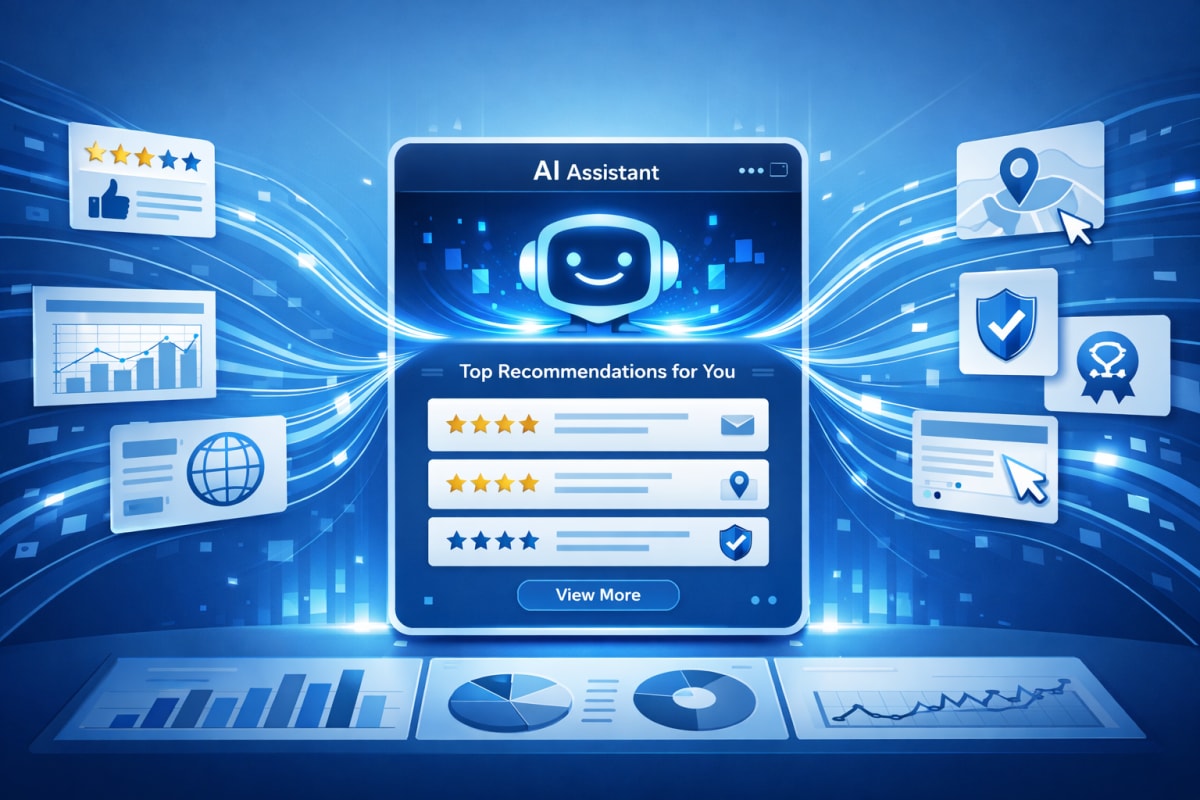
When someone asks Claude or ChatGPT for a business recommendation, the model doesn't just return a list. It synthesizes information from multiple sources, evaluates credibility signals, and presents a curated shortlist of typically three to four options with explanations for each recommendation.
This is a winner-take-most scenario. If you're not in that initial recommendation, you're essentially invisible. There's no page two to scroll to.
How Query Fan-Out Changes Everything
Here's what happens behind the scenes when someone types "I need a handyman in Fort Lauderdale" into an AI assistant: the model doesn't just search once. It uses something called query fan-out, breaking your question into multiple sub-queries and sending out individual searches simultaneously.
- One arm might look at Google reviews.
- Another researches service areas.
- A third investigates pricing information. Another checks licensing and credentials.
- Yet another examines availability and response times.
All of this information comes back to the model, which then synthesizes everything into a coherent, ranked recommendation. The businesses that show up are the ones that had strong, consistent signals across all of these different evaluation criteria.
This is fundamentally different from optimizing for a single search algorithm. You need to be visible and credible across multiple dimensions simultaneously.
What AI Systems Actually Look For: The Complete Audit Framework
When we conduct an AI visibility audit, we examine far more than whether a business appears in AI responses. This holistic approach matters because AI systems don't operate in isolation. They're pulling from your entire digital footprint to form their assessment of your business.
Signal 1: Structured Data and Schema Markup
This is consistently the biggest gap we find in local service business websites, and it's the signal that surprises owners the most.
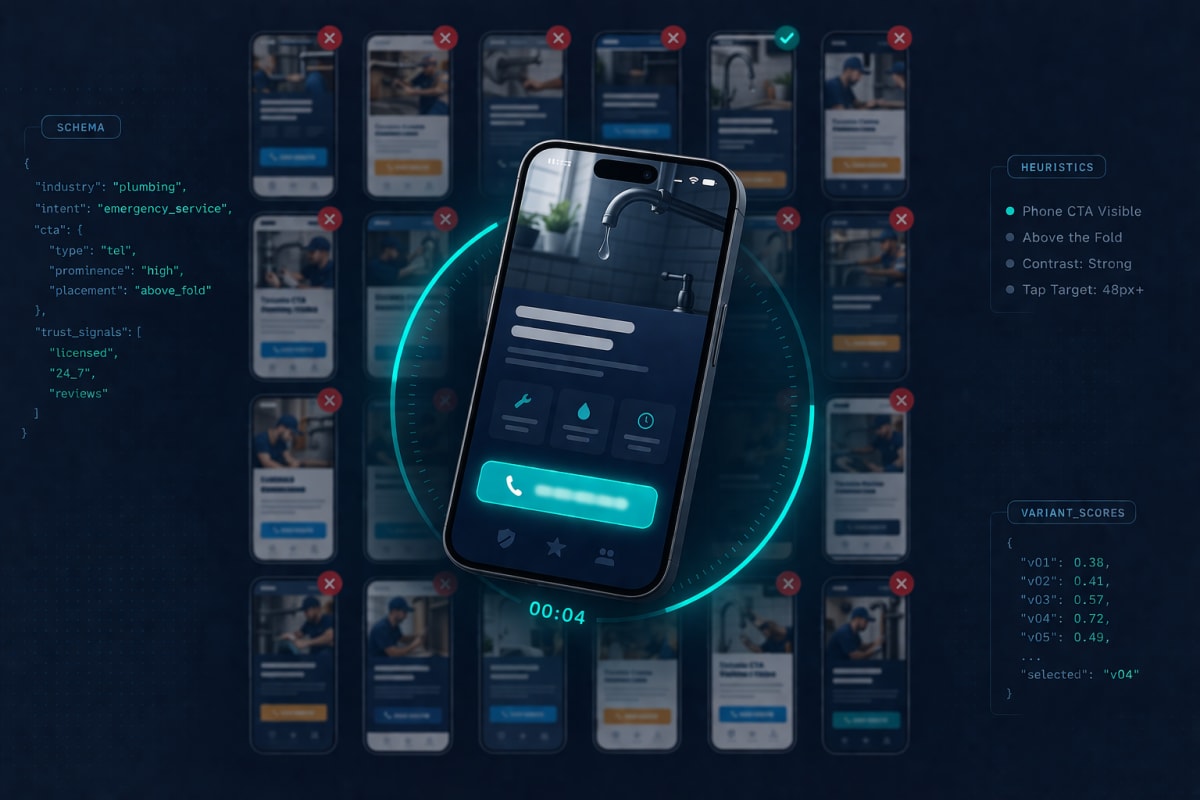
Your website might look beautiful to human visitors. It might have stunning photos, compelling copy, and an intuitive layout. But when an AI crawler visits your site, it doesn't see any of that visual design. It's looking for machine-readable data that tells it exactly who you are, what you do, and who you serve.
Schema markup is essentially a cheat sheet for machines. It's structured code on the back end of your website that explicitly states your business name, address, phone number, service offerings, pricing, hours of operation, credentials, and more. For attorneys, it includes educational background, bar admissions, and practice areas. For contractors, it details licensing, insurance, and service specialties.
Without this structured data, AI systems have to work much harder to understand your business. And here's the thing about AI crawlers: they're fast, they're processing millions of sites, and they're somewhat lazy by design. If information isn't easily accessible, they'll often skip it entirely.
The hidden content problem: Many modern websites use design elements that actually hide content from machines. Accordion menus that require clicks to expand, content that loads only after scrolling triggers JavaScript, information buried in PDFs or images. Humans can navigate these elements easily. AI crawlers typically can't and won't.
Signal 2: NAP Consistency Across All Platforms
NAP stands for Name, Address, and Phone number, and consistency across every digital property is more important for AI visibility than most business owners realize.
Your business exists in multiple places online: your website, Google Business Profile, Facebook page, LinkedIn company page, Yelp listing, industry directories, and dozens of other platforms. AI systems check whether all of these listings refer to the same business by comparing this core information.
Inconsistencies create confusion. If your website lists your address as "123 Main Street" but your Google Business Profile says "123 Main St." and your Facebook page shows "123 Main Street, Suite A," AI systems may not confidently connect these as the same business. This fragmentation weakens your overall authority signal.
The fix seems simple, but the audit process often reveals discrepancies business owners didn't know existed, particularly for businesses that have moved locations, changed phone numbers, or been acquired.
Signal 3: Question-Based Content That Matches Search Intent
Here's where traditional content marketing and AI optimization diverge significantly.
Traditional SEO focused on keywords. You'd research terms people were searching, then create content targeting those keywords. AI systems work differently. They're trying to answer questions, and they're looking for content that directly provides those answers.
The key insight is that AI searches often involve much longer, more conversational queries than traditional Google searches. Someone might not type "roof repair Fort Lauderdale" into ChatGPT. Instead, they might ask "My roof is leaking around the chimney and I noticed some damaged shingles after the last storm. Should I try to fix this myself or hire a professional? If I hire someone, what should I look for in a roofing contractor?"
That's a complex query with multiple implied questions. The businesses that get recommended are the ones whose content addresses these detailed, situational questions in a comprehensive way.
What this looks like in practice:
- Detailed FAQ sections that answer real customer questions in depth
- Blog content that addresses specific scenarios and decision points
- Service pages that explain not just what you do, but when and why someone would need it
- Educational content that helps people understand their problem before presenting your solution
Signal 4: Information Gain Beyond Training Data
This is a more advanced concept, but it's increasingly important for competitive industries.
AI models like ChatGPT and Claude are trained on massive datasets that have a cutoff date. This means the model already "knows" everything that existed in its training set. For common queries, it doesn't need to search the web because the answer is already baked into the model.
But for information that's newer than the training cutoff, or for topics where the model's training data is thin, it needs to go out to the web to find answers. This is where you have an opportunity.
Content that provides genuine information gain -new data, fresh insights, updated regulations, emerging trends -gives AI systems a reason to cite your content specifically. If you're just repeating the same information that exists everywhere else, you're not adding value that forces the model to reference you.
This is why original research, local market insights, and timely updates to your content can significantly impact AI visibility in ways that rehashed generic content cannot.
Signal 5: Validation Signals from Third-Party Sources
AI systems don't just evaluate what you say about yourself. They look for external validation.
This includes Google reviews, and more importantly, your responses to those reviews. It includes mentions on platforms like Reddit, where real users discuss their experiences. It includes comparison sites, industry directories, and anywhere people talk about businesses in your category.
You control your owned content -your website, social profiles, and marketing materials. But AI systems are also checking earned content -what others say about you in spaces you don't control.
The practical implication is that reputation management becomes a visibility factor. Responding thoughtfully to reviews, engaging authentically in community discussions, and ensuring satisfied customers have easy ways to share their experiences all contribute to the validation signals AI systems evaluate.
The Non-Deterministic Challenge: Why AI Recommendations Aren't Predictable
Here's something that frustrates many business owners and marketers: AI recommendations aren't fully predictable or consistent.
Unlike traditional search, where the same query reliably returns the same results, AI systems have built-in variability. The same question asked twice might produce slightly different recommendations. The sub-queries sent out during query fan-out aren't identical every time. The synthesis of information involves probabilistic processes.
This means you can't game the system the way some businesses tried to game Google rankings. There's no equivalent of keyword stuffing or link schemes that guarantee placement. The models are proprietary, meaning we can't see exactly what's happening inside them.
What you can do is optimize across all the signals we've discussed, increasing the probability that you'll be cited and recommended. Consistent, comprehensive optimization improves your odds significantly, even if it can't guarantee any single result.
What Winning Actually Looks Like: Measuring AI Visibility Success
Many business owners ask us how to measure success when there's no dashboard showing AI referral traffic. The good news is that measurement has improved significantly.
Referral traffic from ChatGPT and Claude now typically identifies its source in Google Analytics. You can actually see when visitors come from AI assistants, allowing you to track this channel's contribution to your overall traffic and leads.
But the more fundamental metric is citation tracking. The goal is to have your content cited as part of AI responses. When an AI assistant answers a question and includes a link to your website as a source, that's the gold standard. You've influenced the answer, and your business is now positioned in front of that potential customer.
What success looks like at six months:
- Your business appears in AI recommendations for your primary service categories and location
- You're being cited as a source for informational queries related to your expertise
- Referral traffic from AI assistants shows a consistent upward trend
- Your citation rate for target queries improves month over month
- Lead quality from AI referrals matches or exceeds other channels
What to Do Now: Your AI Visibility Action Plan
Understanding these concepts is valuable, but implementation is what actually moves the needle. Here's a prioritized action plan based on impact and effort.
This Week
Audit your structured data. Use Google's Structured Data Testing Tool to check whether your website has schema markup. Look specifically for LocalBusiness schema, Service schema, and FAQ schema. If these don't exist, you've identified your highest-priority gap.
Check your NAP consistency. Search for your business name in Google and list every place it appears. Compare the name, address, and phone number across all listings. Document any inconsistencies.
Test your AI visibility. Ask ChatGPT and Claude for recommendations in your category and location. Note whether you appear, what's said about you, and which competitors show up. This gives you a baseline.
This Month
Implement or fix schema markup. If your website lacks structured data, work with your developer or marketing team to add comprehensive schema markup. This single change often produces the most significant improvement in AI visibility.
Create question-based content. Identify the top ten questions your potential customers ask before hiring someone in your field. Create detailed, helpful content that directly answers these questions. Make sure the questions themselves appear as headers.
Address NAP inconsistencies. Update all listings where your business information is incorrect or inconsistent. Pay special attention to Google Business Profile, as this is a primary data source for AI systems.
This Quarter
Develop an information gain strategy. Identify topics where you can provide genuinely new or local-specific information. Consider original surveys, local market reports, or timely updates that don't exist in AI training data.
Build your review response system. Implement a process for responding to every Google review within 24-48 hours. Your responses are indexed and influence how AI systems perceive your customer service.
Monitor and iterate. Set up monthly AI visibility checks using consistent test queries. Track your citation rate and adjust your strategy based on what's working.
The Bottom Line
AI systems are making recommendations about local service businesses thousands of times every day in your market. The businesses that appear in these recommendations share common characteristics: comprehensive structured data, consistent information across platforms, content that directly answers customer questions, and validated credibility from third-party sources. The opportunity is significant for businesses willing to optimize across these dimensions, particularly while competitors remain focused solely on traditional SEO.