How to Make AI Your Best Referral Partner: The Full Playbook
Guy Leaf at Webflow revealed internal data showing AI search traffic converts at 6x better than traditional search. Here's the complete playbook.
How to Make AI Your Best Referral Partner: The Full Playbook
The Full Playbook for Local Service Businesses
Today's Promise
I'm sharing our entire AI Search Optimization Playbook for free. This is how we deliver successful marketing outcomes for customers: every strategy, tactic, and hack that works.
Why? Most businesses need this immediately, and waiting means competitors gain permanent advantage. Realistically, 90% won't implement it. But the 10% who do? Your phone will ring constantly.
Why Should You Care About AI Search?
Guy Leaf, Chief Evangelist at Webflow, revealed internal data showing AI search traffic converts at 6x better than traditional search.
Consider this: Would you prefer 100 visitors converting at 2% or 20 visitors converting at 12%?
This matters NOW:
Traditional SEO requires 6-12 months for results. AI Search Optimization can impact visibility this afternoon.
Webflow updated six pages with FAQs and schema markup. Within two weeks, those pages generated 50% of incremental AI citations, with organic traffic jumping 24%. Two weeks, not two years.
LLMs crawl constantly, learning from fresh content. Daily delays mean competitors strengthen in AI's memory. Once AI trusts them over you, reversing that preference becomes nearly impossible.
Who Is Your Website Really For?
Uncomfortable truth: Your website serves people and machines now.
Test your site:
Right-click → "View Page Source"
If HTML makes logical sense (e.g., <title>, <header>, <article>), that's semantic HTML. Good.
If it's short with multiple <script> tags inside nested <div> elements, you're invisible.
AI crawlers, like humans, prefer simple concepts. They don't execute fancy scripts. They scan, read visible content, and move on.
Your site must communicate two languages:
- To humans: Clear, visual, emotionally engaging
- To machines: Structured data, schema, fast load times, semantic markup
Most businesses speak only one language. That's why they disappear in AI search.
The Four Pillars of AI Search Visibility
Pillar 1: Technical Foundation
Schema Markup
This is where 90% fail immediately.
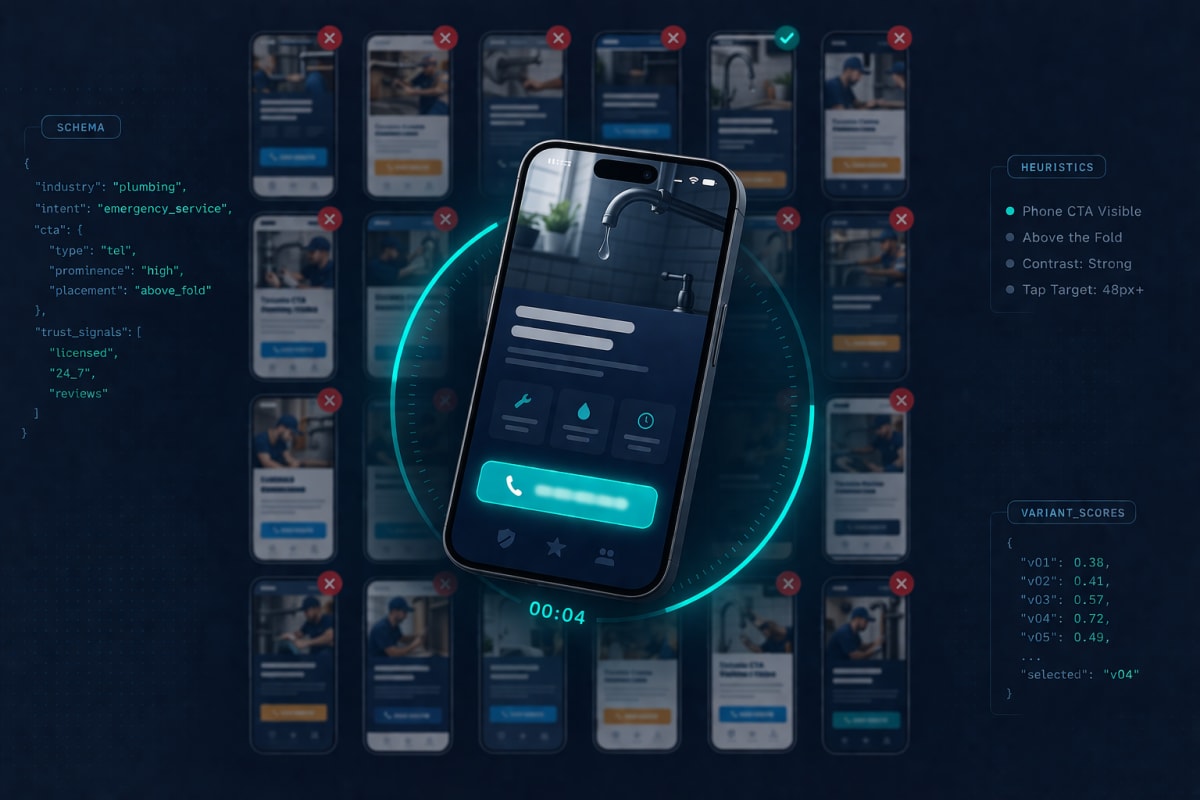
"Schema markup is the cheat code AI actually reads." Instead of AI figuring out "Mon-Fri 8-5" means business hours, schema explicitly states it.
The gap: 88% of websites lack schema. 73% of Google's top results have it.
Minimum requirements:
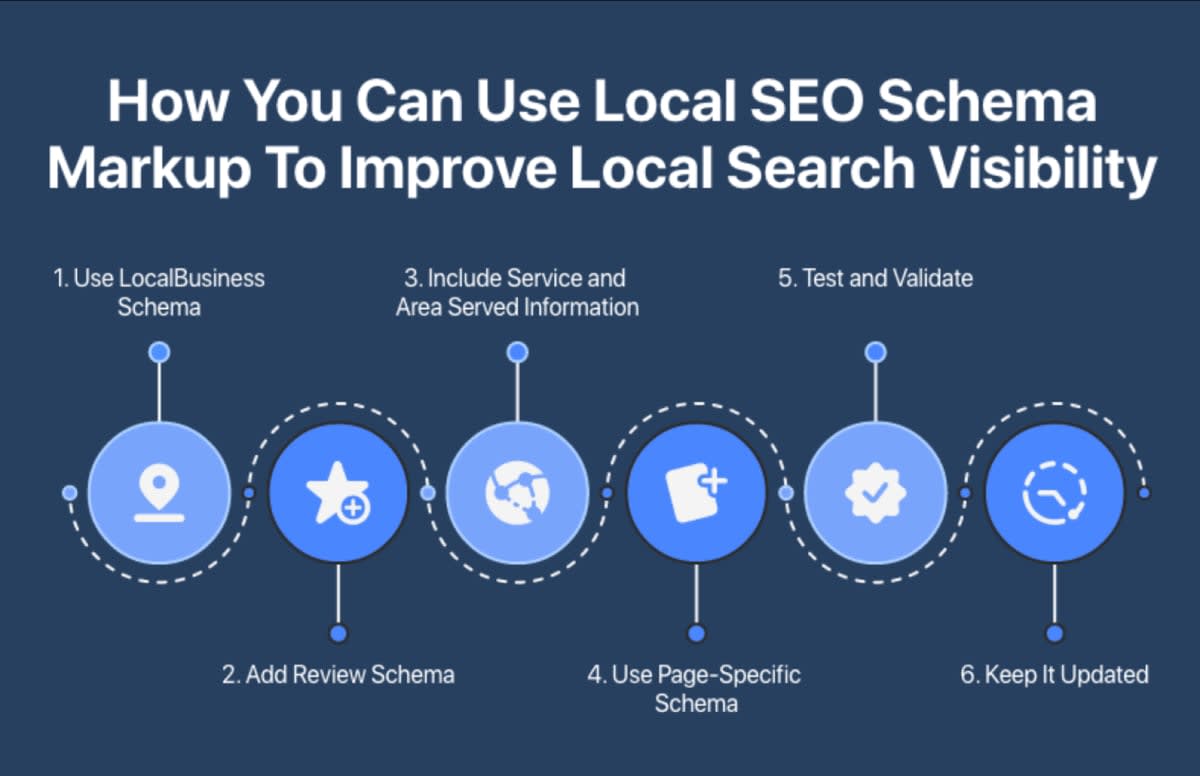
- LocalBusiness or ProfessionalService schema
- Service schema for each offering
- FAQ schema on service pages
- Review schema for testimonials
Adding schema solves both SEO and AI search optimization.
Speed Matters
Crawlers want maximum information quickly. 5MB pages that take forever? Crawlers leave before indexing completes.
JavaScript Rendering Problem
HTML is your house structure. JavaScript is furniture. CSS is paint.
AI tours your house but won't wait for furniture arrangement. If content loads via JavaScript, AI sees an empty room.
Platform limitations:
- Wix: JavaScript-dependent rendering, limited schema, slow Core Web Vitals. ~30% optimization potential
- GoDaddy: Minimal SEO control, limited schema. ~20% potential
- Squarespace: Poor performance, limited customization. ~35% potential
Even limited platforms can achieve significant visibility.
Essential files:
- sitemap.xml: Lists every page
- robots.txt: Specifies crawler permissions
- LLMs.txt: Explains content to AI
Pillar 2: Content That Answers
Mindset shift: Stop asking "What keywords rank?" Start asking "What questions do customers ask?"
Keywords are obsolete. Questions matter.
The difference:
- Average Google search: 4 words
- Average AI query: 23 words
People don't type "plumber Miami" into ChatGPT. They ask: "I have a leak under my kitchen sink and water's pooling. What do I do? Who should I call in Miami?"
Content reality:
Your 200-word service page isn't content. It's a business card. Real content requires 1,000+ words minimum, answers 5-7 related questions, includes examples, and provides actual value beyond "call for a free quote."
Website audit: Fewer than 10 pages? You have a digital business card, not a website.
Freshness advantage:
Content with freshness indicators gets 1.8x more AI citations. Monthly updates double visibility:
- Update top 5 pages
- Add new FAQs
- Include recent examples
- Add "Last updated: [Date]" prominently
Two hours monthly effort yields double visibility.
The listicle strategy:
Create "Top 10 [Your Service] Providers in [Your City]" and list yourself first (with 9 competitors).
"That's promoting competitors!"
No. You're demonstrating confidence. When multiple sites agree on top providers, including yourself, consensus builds. Competitors "too proud" to do this? They're invisible while you're the trusted curator.
Pillar 3: Authority Building
Authority extends beyond your website. It's your entire digital footprint.
NAP Consistency Trap
NAP = Name, Address, Phone. Inconsistencies confuse AI.
Examples of confusion:
- "AAA Plumbing" vs. "AAA Plumbing Inc." vs. "AAA Plumbing, Inc."
- "123 Main St" vs. "123 Main Street" vs. "123 Main St."
- "(555) 123-4567" vs. "555-123-4567" vs. "555.123.4567"
One inconsistency breaks everything. Audit Google Business Profile, Facebook, LinkedIn, Yellow Pages, Yelp, and every directory.
Reviews matter beyond ratings:
AI reads content, not just stars. A 5-star "Great!" is weaker than a 4-star "They solved my emergency leak at 10 PM Saturday, arrived within an hour, charged exactly what quoted."
Review milestones:
- Under 10 reviews: You barely exist
- 10-40 reviews: Real but untrusted
- 40+ reviews: Conversion rate doubles
- 100+ reviews: Bulletproof authority
System: After each job, within 48 hours, send direct review link (not "please review us"). Target 2-3 reviews monthly = 24-36 yearly. Dominance in 3 years.
Earned media revolution:
Mentions matter more than backlinks. Every plain-text business mention online (forums, comments, social posts, local news) signals trust.
- Customer Nextdoor post? Trust signal
- Facebook community recommendation? Trust signal
- Local business newsletter mention? Trust signal
You can't buy this. You earn it by being worth discussing.
Pillar 4: Measurement That Matters
Forget traditional metrics. Keyword rankings don't exist in AI. Impressions without mentions are meaningless.
Share of voice is critical: How often are you mentioned when AI answers category questions?
Weekly testing:
Ask AI:
- "Best [your service] in [your city]"
- "Who should I call for [specific problem]"
Track in spreadsheet:
- Date
- AI platform
- Query asked
- Were you mentioned?
- Mention position/context
- Competitors mentioned
Sentiment matters equally:
"AAA Plumbing (reliable but pricey)" vs. "AAA Plumbing (go-to emergency plumber in Miami)"
First positions you as expensive. Second positions you as essential.
Track high-priority queries:
- Your exact service in your area
- Emergency services near local landmarks
- Specific problems you solve
No appearance = fundamental visibility problems.
The Cost of Platform Limitations
Your platform might sabotage you.
14.7 million people shop via AI weekly. Your platform blocks 70% optimization potential. Competitors on better platforms gain 40-60% more visibility.
ROI calculation:
- Platform migration cost: $750-2,500 (one-time)
- Yearly missed opportunity cost: Thousands
- Break-even: 2-3 months
The Missing Piece: Freshness
Everything mentioned expires in ~30 days.
85-95% of ChatGPT citations come from content updated in the last 10 months (not created, but updated).
Reality check: Perfect implementation today becomes invisible next month without maintenance.
Your business stops speaking if content hasn't been updated. Would you trust a restaurant whose last Instagram post was 2023? A contractor whose last blog post was "Happy New Year 2024"?
Neither would AI.
The content competition:
You're competing against the entire internet's publishing schedule. Daily non-publication means someone else publishes. AI reads everything.
Winning formula:
You don't need to become major media. Answer one new question weekly. Share one customer success story. Update one page. That's three monthly pieces of content.
You're ahead of 90% of competitors.
The businesses dominating aren't better. They show up consistently. They answer regularly. They prove they exist and care.
Your 30-Day Roadmap
Step 1: Current State Assessment
- Run audit for AI visibility
- Document platform limitations
- Assess content (quantity, freshness, location)
- Establish baseline metrics
Step 2: Quick Wins
- Fix NAP consistency (free)
- Add FAQ sections
- Claim directory listings
- Implement review system
Step 3: Content Strategy
- Identify team for content creation/updates
- Map where to build authority via updates
- Identify new content gaps
- Set update frequency
Step 4: Decision Time
- Analyze platform migration ROI
- Determine outside help needs
Subscribe to Booked Solid for weekly digital marketing strategies designed for local service businesses.