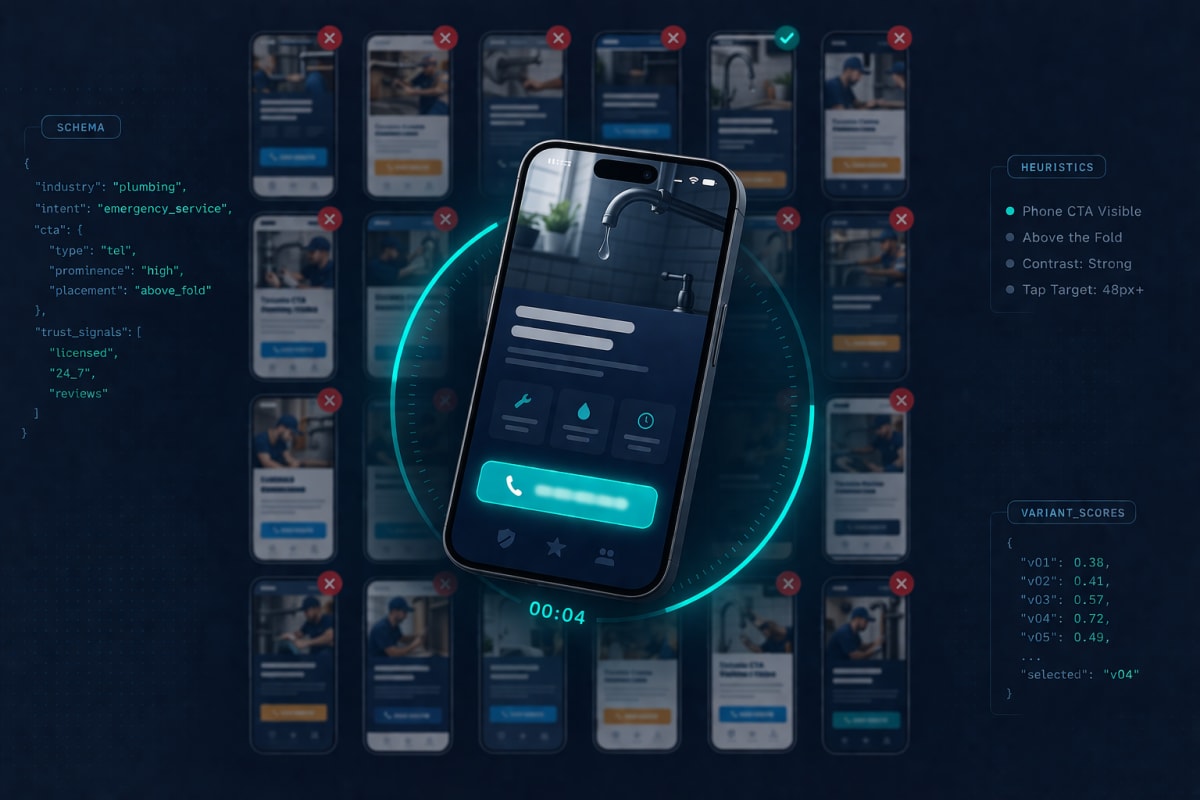
Call the Plumber: When Your Customer Brings an AI Agent to the Estimate
The estimate was $2,400. The customer pulled out her phone, typed three sentences into ChatGPT, and looked back up. 'It says this should be $1,800. Can you explain the difference?' The contractor had three choices in that moment, and only one of them keeps the job and the margin.

The estimate was $2,400. The customer pulled out her phone, typed three sentences into ChatGPT, and looked back up.
"It says this should be $1,800. Can you explain the difference?"
The contractor had three choices in that moment, and only one of them keeps the job and the margin.
He could panic and discount. He could push back and lose the customer to the next contractor down the road. Or he could do the thing almost no one in his trade has been trained to do: walk her through the $600 gap, line by line, in a way that left her smarter about her own house than she was when she Googled the question.
This is the new shape of every estimate. Not someday. Now.
The Abstraction Just Leaked
A few weeks ago, Andreessen Horowitz published an essay called "Call the Plumber; We've Got a Leaky Abstraction." The premise is simple. The big systems we rely on every day, including global trade, the oil market, online checkout, paper checks, are what software engineers call "abstractions." Reliable interfaces built on top of less-than-reliable parts. They look simple from the outside. They are extraordinarily complex underneath. As long as the abstraction holds, customers don't need to think about the complexity. They trust the interface.
Local services are an abstraction too.
For thirty years your customers paid for a black box. They didn't see the parts pricing, the markup, the labor model, the warranty math, the dispatch overhead. They didn't see the difference between a 2018 unit and a 2022 model with a redesigned compressor. They didn't see why permitting in one municipality costs more than the next county over. They paid for the result, and they trusted the contractor.
The same has been true in legal. For decades, lawyers have hidden behind a wall of jargon and a flat hourly rate. The client paid for the wall. They didn't see the research, the drafting, the citations, the seventeen-minute call to opposing counsel. The wall was the product.
The a16z essay's bigger point is that abstractions leak. When ordinary people get to look behind the curtain, they grab the controls. That's happening right now in oil markets, in trade policy, in payments. It is also happening at the kitchen table during your estimate, and on the other end of every retainer email.
ChatGPT now handles roughly 12% of the search volume that traditionally went to Google, and the gap is closing fast. The average ChatGPT query is sixty words long. The average Google query is 3.4 words. That's a 17x difference in how much context the customer is feeding the model before they call you. (For more on how this is playing out across industries, Kyle Poyar's recent "What's Working Right Now in AI Search" breakdown is worth reading in full.) Customers aren't typing "AC repair near me" anymore. They are typing "my AC unit is making a clicking noise on startup, the contractor wants to replace the capacitor for $340, is that fair?" And the AI answers.
Here's what most contractors and most lawyers never calculated. This shift isn't a five-year shift. It's a six-month shift. The customer who pulls out their phone in the middle of your estimate is not an outlier. They are the new median.
Two Truths That Sound Opposite
There are two truths in this moment, and most owners pick one of them. The owners who pick both are the ones who pull away from the field.
Truth 1: Transparency wins now.
The contractor who treats the customer's AI as an ally, who pulls up the line items, shows the math, and explains why a $400 capacitor is a $400 capacitor, is the one who closes the deal at full price. Hiding behind "trust me, I've been doing this for twenty years" used to be sufficient. In 2026 it reads as evasion. Every customer with a phone has a second opinion in their pocket, and the contractor who refuses to engage with it loses the room.
The same applies to the legal industry, maybe more so. The client who pasted your retainer agreement into Claude already knows that two of the clauses are non-standard. The lawyer who walks them through why those clauses are there keeps the client. The lawyer who waves it off as "boilerplate, don't worry about it" loses to the firm down the street that explains it.
Truth 2: AI is wrong, often, and you are still the expert.
ChatGPT doesn't know your local code. It doesn't know that the municipality requires a permit and an expansion tank for the configuration the customer is asking about. It doesn't know the house was built in 1962 and the existing line is half-inch copper that won't carry a high-efficiency unit. It doesn't know the manufacturer voided the warranty on that model last year and the only equivalent unit on the market now sells at a meaningful premium.
In legal, the gap is even wider. ChatGPT doesn't know that the appellate court for your circuit reversed the precedent your client is leaning on. It doesn't know that the firm on the other side of this case settles 80% of these matters the week of trial, not in mediation, which means their first three offers aren't real and your client should hold the line. It doesn't know that the relevant notice statute has a tight window that starts from a different date than the client thinks. AI knows the words. It does not know the texture.
A research team at Graphite published a study in April called "Demystifying Randomness in AI." Their finding is worth landing carefully: AI outputs are statistically measurable, and the underlying model is largely deterministic. Translation: when ChatGPT gives a customer the same answer twice, that's not coincidence. The model is doing math, not magic. But determinism is not the same as accuracy. Consistent does not mean correct. The expert who knows where the AI is consistently wrong is the irreplaceable node in the system.
The trap
Most owners pick one truth, not both.
Pure transparency without expertise is a race to the bottom. The customer thinks they understand everything, picks the cheapest bid, and you become a commodity.
Pure expertise without transparency is a bid loss. The customer feels talked down to, walks, and hires the contractor or the lawyer who explained more, even if that one was wrong.
The synthesis is the line worth tattooing on the wall of every shop and every law office in 2026: your job is to leave the customer more informed than when they arrived, including more informed than their AI made them.
Don't Dispossess the Customer
This is the part most contractors and most lawyers get wrong, and it is the part that decides whether you keep the relationship.
When the AI is wrong, you cannot say "your AI is wrong, trust me." That dispossesses the customer of the knowledge they think they have. They feel stupid. They get defensive. You lose the room, and you lose them as a customer for life. The customer didn't show up wanting to fight you. They showed up wanting to be a smart consumer. Honor that.
The frame is: honor what they thought they knew. Add what they didn't know existed. Let them keep the win.
Let me tell you about Mike, who runs an HVAC shop in central Florida. Most of you have heard me talk about Mike before. He is the guy who rebranded from "licensed HVAC contractor" to "The AC Teacher" a few years ago. He charges 40% more than the shop down the street and has not run a Google Ad in two years.
In the pre-AI era, Mike's job was to explain how the system worked. In 2026, his job is more specific. Mike completes the picture his customer's ChatGPT started. He doesn't contradict the AI. He extends it.
When a customer says "ChatGPT told me the capacitor swap should be $180," Mike says: "You're right. A basic capacitor replacement on most units is around $180. Here is what that quote was missing. Your unit is from 2018, and at that age the contactor is almost always showing wear too. The two parts work together, and a capacitor failure usually means the contactor was the underlying cause. We test and replace it on the same visit, which adds about $90 in parts and twenty minutes of labor. The reason our price is higher is not that we are more expensive. It's that the cheaper version is the price of being wrong about what is actually happening in your system."
The customer leaves smarter, not corrected. That is the whole game.
The same move works in legal. Sarah runs a four-person commercial litigation practice in Tampa. A client emails her: "I ran the settlement offer through Claude. It says the indemnification clause is standard and we should sign."
The lawyer who responds "no, don't sign" loses the client's confidence. The lawyer who responds "Claude is right that the language is standard for most contracts. In your case, that clause is the issue. You are indemnifying for a category of damages your insurance doesn't cover, which means a single claim could cost you personally. Standard language, non-standard exposure. Here is why that distinction matters in your specific situation."
That lawyer just made the client more capable, not less. The client tells two friends.
In Silicon Valley, they call this additive feedback. I call it the educator's discount. The contractor or the lawyer who teaches keeps the customer for the next twenty jobs, not just this one.
The Four-Part Response
When an AI-armed customer challenges your quote or your advice, the response moves in four steps. This works for HVAC. It works for plumbing. It works for legal. It works for accountants, dentists, electricians, roofers. The substance changes. The structure does not.
Step 1: Validate the question.
"That is a fair question, and it is the right one to ask." You are rewarding the behavior, not punishing it. The customer who shops your quote is the customer who is about to be your most loyal client if you handle this right. Defensive contractors lose. Curious contractors keep the room.
Step 2: Show the math.
Open the quote line by line. Parts, labor, permit, haul-away, warranty, dispatch. For lawyers: hours by task, by attorney, by paralegal, with a one-line description of what each block of time was for. Most contractors send a single number. Most lawyers send a single retainer figure. The contractor who sends six numbers wins. The lawyer who sends a sixteen-line invoice with descriptions wins. You are not exposing yourself. You are building defensibility.
Step 3: Surface the gap.
Where is the AI's estimate missing context? Local code. Building age. Warranty terms. Insurance requirements. Subcontractor liability. Specific case law. Statutory deadlines. Be specific. Name the part, the code section, the manufacturer, the case. Vagueness signals you don't know. Specificity signals you do.
Step 4: Restate the expertise.
"Here is what fifteen years of doing this taught us that ChatGPT doesn't know yet." Land the value in a single sentence. Not a brag. A service. The customer should hear: I am the safety net you wouldn't have known you needed without this conversation.
Bonus move that almost no one uses: end with "want me to send you the spec sheet on this part so you can run it past your AI?" or "I can send you the case citation so you can verify what I just told you." You just turned the AI from an adversary into a tool you handed them. Now they trust you and the AI.
What This Changes About How You Operate
You can't just train your team on a script. The whole shop has to change a little.
Quote and invoice templates. Switch from a single total to a line-itemized quote, every time. Every contractor and every lawyer will be doing this within two years. You can be early. Early is leverage.
Website glossary content. When a customer Googles or ChatGPTs a part name from your invoice, or a clause from your retainer, your website should be the page that gets cited. This is where Answer Engine Optimization stops being theoretical. The page on your site explaining "what is an expansion tank and why does Florida code require one" is the page ChatGPT cites in 2026. The blog post on your firm's site explaining "what does a typical indemnification clause actually do" is the page Claude cites when your prospect's AI does its research the night before they call you.
FAQ reframe. Most service business FAQs answer questions customers used to ask the receptionist. Reframe them as "what your AI is telling you, and what it might be missing." That is the page customers will read in 2026. That is also the page their AI will read.
Train your team. Every estimator, every dispatcher, every paralegal, every office admin needs to recognize the AI-augmented customer and have the four-part response ready. The AI-augmented customer no longer fits the old sales-training playbook. They are not skeptical. They are over-confident. The training is different.
Document your edge cases. Every time AI gets your trade or your area of law wrong in a customer conversation, write it down. That document is the most valuable AEO content you will ever produce. It is also the foundation for the agent-readiness conversation that is coming for every vendor in your stack.
Where This Is Going
The customer at the kitchen table with ChatGPT is the easy version. The harder version is coming.
In the next six months, the customer's AI agent will not be at the estimate. It will be before the estimate. The agent will pull three quotes, normalize them, score them against reviews, and recommend one before the customer ever calls you. You either show up on the recommended list, or you don't.
In the next twelve months, the agent will be doing the negotiation directly with your scheduling system, your CRM, and your pricing API. The contractor whose software stack can't be driven by an agent is the contractor who falls off the recommendation list entirely. Same for the lawyer whose intake form lives in a PDF.
The contractors and the lawyers who already learn to teach are the ones whose business survives the agent layer. The ones who already shifted to itemized quotes, who already wrote the glossary content, who already trained their team to honor the customer's AI without surrendering to it. The ones who didn't will compete on price against firms they have never met, refereed by an AI that doesn't know them.
This is the Move 37 of customer trust. It shows up first at the estimate. By the time it shows up at the agent layer, the contractors and the lawyers who haven't moved are already behind.
Your Action Plan
You don't have to ship all of this at once. You do have to start.
- Take your three biggest recent quotes or three biggest engagement letters. Paste a description of the job into ChatGPT and ask what the work should cost or what the engagement should look like. Read your version next to the AI's version. Where is the gap? Can you defend every dollar or every hour of it in plain English? If you can't, that is the next thing to fix.
- Audit your quoting or invoicing template. If it sends a single total, rebuild it to send line items with one-line descriptions. The contractor or the lawyer with six numbers and six descriptions wins the AI second-opinion conversation every time.
- Pick the top three questions your customers' AI is getting wrong about your trade or your practice area. Write a 600-word page on each, on your website, with specific examples. That content is your AEO investment for the year.
- Train your front-line team on the four-part response. Validate, show the math, surface the gap, restate the expertise. Twenty minutes in a team huddle is enough to start. The behavior compounds.
The good news? You are reading this in 2026, not 2028. The contractors and the lawyers who start teaching now will be on the inside of every AI recommendation in their market two years from now. The ones who wait will be wondering why their phone stopped ringing.
The abstraction is leaking. Call the plumber. Or be one.