Your Biggest Revenue Leak Isn't Your Marketing: It's the Cross-Sell You're Not Making
Your CRM is full of untapped revenue. Learn how to map cross-sell opportunities, build automated workflows, and stop chasing cold leads when warm money is si...
Your Biggest Revenue Leak Isn't Your Marketing: It's the Cross-Sell You're Not Making
How much did you spend chasing cold leads last quarter? Now here's a harder question: how much revenue was already sitting inside your CRM, attached to customers who know you, trust you, and have already handed you their credit card, that you completely ignored?
Most multi-service businesses pour money into the top of the funnel while neglecting an asset that's orders of magnitude easier to monetize: their existing customer base. The math is simple but brutal. Acquiring a new customer costs five to seven times more than selling to someone who already knows your name. And yet, the vast majority of businesses with multiple service lines, product categories, or divisions under one umbrella have zero systematic process for identifying and acting on cross-sell opportunities.
This isn't a marketing problem. It's a revenue infrastructure problem. And once you see it, you can't unsee it.
Here's what you need to know, and exactly how to fix it.
The Hidden Revenue Problem Nobody Talks About
Every business owner has been told the same story: spend more on ads, generate more leads, close more deals. The entire agency ecosystem is built around this narrative because it's simple to sell and easy to measure. More impressions. More clicks. More form fills. More invoices from your marketing team.
But this narrative has a blind spot the size of a freight train.
When you run a business with multiple service lines, or a portfolio of companies serving overlapping audiences, the biggest growth opportunity isn't at the top of the funnel. It's in the middle and the right side of what we call the bow tie model. It's in the customers who already bought from Division A but have no idea Division B even exists.
Why Multi-Service Businesses Are Especially Vulnerable
Consider a real scenario. A group of companies, grown through acquisition, all serving the same target audience. One division sold physical products through an online store. Multiple other divisions sold services, things like home health care. Same customer profile. Same demographic. Same needs. And yet each division operated in its own silo, with its own CRM data, its own marketing budget, and its own customer list.
The overlap was enormous, and the cross-sell opportunity was just sitting there, invisible.
"Somebody who had purchased something on the online store may very well need some of the services provided by other businesses under the umbrella. So the thing that we built for them was really a cross sell tool to help them identify customers from other businesses that they also owned that could be upsell potential for their existing customer base."
This isn't an edge case. This is the default state for most businesses that have expanded through acquisition, added service lines over time, or grown organically into adjacent markets. The customer data exists. The audience overlap exists. What doesn't exist is the system to connect the dots.
The Real Cost of Ignoring Your Own Data
Let's put some numbers to this. Say you have 2,000 active customers across three divisions. If even 15% of customers in Division A are viable candidates for Division B's services, that's 300 warm leads you're not working. If your average deal size for Division B is $1,500 and you close just 20% of those warm leads, that's $90,000 in revenue. No ad spend. No cold outreach. No new customer acquisition cost.
Now multiply that across every division-to-division combination. For a company with four or five divisions, the number gets very large, very fast.
And here's the kicker, these aren't strangers. These are people who already trust your brand, have already given you payment information, and have already had a positive enough experience to remain a customer. The conversion math is fundamentally different from cold lead generation.
Why Businesses Chase Cold Leads Instead of Cross-Selling
If the opportunity is so obvious, why does almost every multi-service business miss it?
The answer comes down to three structural problems.
Siloed Data and Siloed Teams
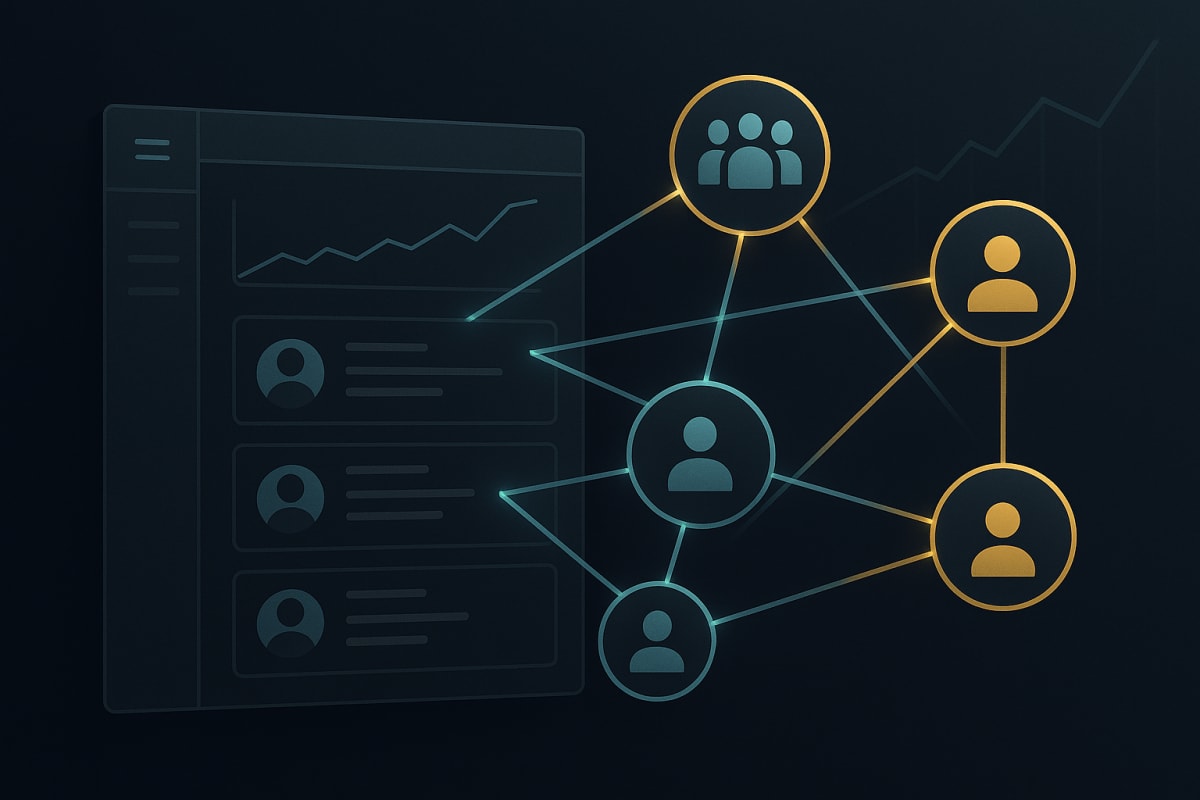
When companies grow through acquisition, or even just by adding service lines, each unit tends to develop its own tech stack, its own customer records, and its own sales process. The CRM for the product division doesn't talk to the CRM for the services division. Field reps in one unit have no visibility into what customers are doing in another. There's no single view of the customer across the organization.
This isn't a technology problem. It's an architecture problem. And it means that the richest source of sales intelligence your business has, your combined customer data, is locked in separate rooms with no doors between them.
The Ad Spend Addiction
Most businesses default to what's familiar. Running Google Ads, boosting Facebook posts, buying leads from aggregators, these activities feel productive because they generate visible activity. Impressions go up. Click counts go up. The monthly report from your agency looks busy.
But activity is not the same as productivity. And it's really hard to cut through the noise these days. The cost of acquiring attention from strangers keeps climbing while the cost of reaching your existing customers is essentially zero.
"It's easier to convert people that already know about your service or are already in your network or may already even be your customer into additional revenue. Just by exposing them to things that they didn't know that you did."
That last part is critical: things they didn't know that you did. Many of your customers have no idea about the full scope of what you offer. Not because you're hiding it, but because nobody has ever systematically told them.
No System for Surfacing Opportunities
Even when businesses recognize the cross-sell opportunity intellectually, they lack the operational infrastructure to act on it. A field rep servicing an HVAC customer doesn't know that the same customer just bought air filters from the online store for the third month in a row. The person managing the durable medical equipment catalog has no idea that a customer also receives home health care services from a sister company.
Without a system that surfaces these connections automatically, cross-selling depends entirely on individual initiative and tribal knowledge. And that doesn't scale.
The Diagnostic Process: How to Find Your Hidden Revenue
Finding the money already in your CRM isn't guesswork. It's a structured diagnostic process. Here's how to approach it.
Step 1: Map Your Divisions, Services, and Audiences
Before you can identify cross-sell opportunities, you need a clear map of what you sell and to whom. This sounds elementary, but most multi-service businesses have never actually documented this in a unified way.
Create a simple matrix:
- Rows: Each division, service line, or product category
- Columns: Customer demographics, use cases, purchase triggers, and average deal value
- Intersections: Where audiences overlap
The goal is to identify every combination where a customer of Service A is a plausible buyer of Service B. In the health care example, someone receiving home health services is a strong candidate for durable medical equipment. Someone buying medical supplies online may need in-home care coordination. These adjacencies are often intuitively obvious once you lay them out, but nobody has laid them out.
Step 2: Identify Overlapping Audiences in Your Data
Once you have the map, go look at your actual customer data. Pull lists from each division's CRM, e-commerce platform, or service management system. Run matching logic, email addresses, phone numbers, physical addresses, company names, to find customers who appear in multiple systems.
You're looking for three things:
- Existing multi-division customers: People already buying from more than one unit (these are your model customers, study them)
- Single-division customers with high cross-sell potential: People buying from one division whose profile matches the ideal customer of another
- Recurring purchase patterns: Customers who buy the same physical products repeatedly, which signals an opportunity for subscription programs that lock in predictable recurring revenue
Step 3: Build Agentic Workflows That Surface Opportunities
This is where modern AI infrastructure changes the game entirely. Instead of relying on manual list pulls and quarterly reports, you can build agentic workflows that continuously consume data from website form fills, CRM records, purchase histories, and service interactions, and automatically surface cross-sell opportunities to the right people at the right time.
What does this look like in practice? The workflow consumes data from across your systems, runs it through custom screening criteria specific to your business, and then pushes actionable intelligence to field sales reps, account managers, or even automated outreach sequences. The rep visiting a home health care client gets a notification: "This customer purchased a mobility aid from the online store last week. They may be a candidate for physical therapy services."
The system takes data you're already collecting from existing customer bases and transforms it into actionable sales intel for the people who can actually do something with it.
Step 4: Automate Personalized Incentives
Once you can identify cross-sell candidates, the next layer is making it easy, and attractive, for them to take action. This means automating personalized offers.
For example: a customer who has been receiving services from one division gets an automatically generated custom discount coupon for physical products from another division, based specifically on the services they're already consuming. The offer is relevant because it's driven by actual behavior data, not generic blast marketing.
This is the same approach Fortune 500 companies have used for years, Amazon's "customers who bought this also bought" engine is the most visible example. The difference is that today, with AI-powered automation, a 15-person service business can run the same playbook without a team of data scientists.
What Most Businesses Get Wrong About Cross-Selling
Before you start building cross-sell infrastructure, there are a few critical mistakes to avoid.
Selling Too Early in the Customer Journey
When a customer books an appointment with you, your only job is to confirm that appointment and deliver clear next steps. Make the message valuable for the customer and nothing else. Your goal is to get them to the consultation, the technician visit, or the phone call. There will be plenty of time to talk about other products and services after you've delivered value on the first one.
Pushing cross-sell offers before the customer has even experienced your primary service destroys trust and increases churn. Sequence matters.
Going a Mile Wide and an Inch Deep
Some businesses get excited about the cross-sell opportunity and try to roll out five or six initiatives simultaneously, new bundles, new offers, new outreach sequences for every possible combination. This is a recipe for half-baked execution.
Keep things organized with distinct goals and outcomes from your target customer's perspective. Pick the single highest-value cross-sell combination, build the workflow, prove it works, measure the results, and then expand. You can't build six things at once and do any of them well.
Neglecting the Foundation
Cross-sell automation only works if the underlying customer data is clean and the systems are properly connected. If your CRM is a mess, duplicate records, missing contact information, inconsistent data entry, no amount of AI workflow magic will save you. The diagnostic process starts with data hygiene.
What to Do Now
Here's your action plan, broken down by timeframe.
This Week
- Audit your service map. List every division, service line, and product category your business offers. Identify which ones serve overlapping customer profiles. You can do this on a whiteboard in 30 minutes.
- Pull your customer lists. Export customer data from each division or system. Even a basic spreadsheet comparison, matching email addresses across lists, will reveal how much overlap exists.
- Calculate the opportunity. Take your overlap number, multiply by average deal size, and apply a conservative conversion rate. This gives you a rough dollar figure for the hidden revenue in your CRM.
This Month
- Identify your highest-value cross-sell pair. Which two divisions or service lines have the most overlap and the highest combined deal value? Start there.
- Design the screening criteria. What signals indicate a customer from Division A is a good candidate for Division B? Purchase history, service frequency, geographic proximity, specific products bought, define the filters.
- Launch a manual pilot. Before building automation, test the concept. Give your field reps a list of 50 cross-sell candidates and a simple script. Measure conversion rates. This validates the opportunity before you invest in infrastructure.
This Quarter
- Build the agentic workflow. Connect your data sources, implement the screening criteria, and automate the process of surfacing cross-sell opportunities to the right people. This is where the real leverage kicks in.
- Automate personalized offers. Set up custom discount coupons or bundled offers triggered by specific customer behaviors or profiles. Make it easy and attractive for customers to buy across divisions.
- Create a recurring revenue layer. Identify customers making repeated purchases of the same physical products and offer subscription programs. This converts unpredictable one-time sales into locked-in monthly recurring revenue.
- Implement a newsletter or communication strategy. Simple, subscriber-driven email campaigns that expose your existing customer base to the full range of products and services you offer. Many customers stick around longer, extending their lifetime value, simply because you stayed in front of them consistently.
Self-Audit Checklist for Multi-Service Businesses
Use this checklist to assess where you stand right now:
- Do you have a unified view of customers across all divisions? If your divisions use separate CRMs with no data sharing, you're flying blind on cross-sell.
- Can a field rep in Division A see a customer's activity in Division B? If not, you're relying on luck instead of infrastructure.
- Have you mapped every audience overlap between service lines? If this lives only in someone's head and not in a documented matrix, it's not actionable.
- Do you have any automated workflow that flags cross-sell candidates? Manual quarterly list pulls don't count. Opportunities decay quickly.
- Are you running any personalized offers based on customer behavior data? Generic promotions are noise. Behavior-triggered offers convert.
- Do your existing customers know about all your services? Survey ten customers at random. If more than half are surprised by something you offer, you have a communication gap that's costing you money.
- Have you identified recurring purchase patterns? Customers buying the same product three or more times are subscription candidates, predictable revenue waiting to be captured.
- Is your customer data clean enough to power automation? Duplicate records, missing fields, and inconsistent formatting will undermine every cross-sell initiative you build.
If you answered "no" to more than three of these, your biggest revenue opportunity isn't a new ad campaign. It's the infrastructure to monetize the customers you already have.
The Bottom Line
The most expensive lead you'll ever generate is the one you didn't need to generate at all, because the customer was already in your database, already trusted your brand, and just needed to know about one more thing you could do for them. For multi-service businesses, the cross-sell gap isn't a minor optimization. It's often the single largest revenue lever available, and it requires zero additional ad spend to pull.
Stop chasing cold leads while warm revenue sits untouched in your CRM. Build the infrastructure to find it, surface it, and act on it.
Want to see exactly where the hidden revenue sits in your business? Reach out to GTM37 for a diagnostic workshop, we'll map your cross-sell opportunities and show you what the data already knows.