Your Brand Is Your Only Moat: Why the Best Marketing in the World Can't Save a Forgettable Business
If I asked 10 of your customers what makes you different from your competitors, would they all say the same thing? Without brand, you're still just another option in a sea of options.
If I asked 10 of your customers what makes you different from your competitors, would they all say the same thing?
Or would you get 10 different answers... or worse, 10 versions of "they do good work"?
I'm always on the lookout for patterns that separate thriving service businesses from those just getting by. And I've found one that changes everything: the businesses that dominate their markets aren't just good at what they do. They've built something their competitors can't copy: a brand position so clear that customers use their name as a verb.
You know these businesses. The realtor everyone calls when selling. The contractor who's booked six months out. The plumber whose customers won't use anyone else. When you look at them, you might see businesses with great reputations. But I see something else: businesses that understood brand is the only sustainable competitive advantage in a world where everyone can buy the same ads, use the same AI tools, and offer the same services.
Last week we talked about how AI is changing the buying journey. The week before, we covered content marketing. But here's what ties it all together: without brand, you're still just another option in a sea of options.
So in this noisy, AI-driven landscape where everyone's fighting for attention, how do you become the obvious choice?
The answer is brand. Not logos and business cards, but owning a specific position in your customer's mind that no one else can claim.
Why Brand Works (And What It Actually Is)
Let me tell you about Mike, an HVAC contractor in Coral Springs. Five years ago, he was like every other AC company, competing on price, buying Google ads, hoping for the best. His marketing message? "24/7 service, licensed and insured." Sound familiar?
Then Mike noticed something. His best customers weren't thanking him for fixing their AC. They were thanking him for explaining what went wrong. "You're the first person who actually showed me what was broken," they'd say. "Now I understand why this happened."
So Mike did something his competitors thought was insane. He started spending 30 minutes on every call teaching customers about their systems. He created YouTube videos showing common problems. He became "The AC Teacher," the only HVAC company in South Florida that teaches you to fix simple problems yourself.
Today? Mike charges 40% more than average. He hasn't bought a Google ad in two years. And when someone asks ChatGPT for an AC company that will "explain everything and not talk down to me," guess who it recommends?
Mike went from $400K to $1.8M in revenue not by being better at fixing ACs, but by owning a position nobody else wanted: the educator.
The Three Types of Service Businesses
When you look at service businesses through the lens of brand, a pattern emerges. Every business falls into one of three categories:
Type 1: The Commodity (90% of businesses)
These businesses compete on price and availability. Their entire message is "we do [service]." Customers see them as interchangeable options.
Real example: Generic cleaning services that flood Facebook with "Book today!" posts. Average ticket: $120. Customer lifetime value: $240 (they switch constantly).
Type 2: The Vendor (9% of businesses)
These businesses compete on features and credentials. They're "better" but not different. Customers comparison shop between them.
Real example: Most law firms: "Board certified, 20 years experience, free consultation." They get business but constantly fight on price. Average matter: $3,500.
Type 3: The Brand (1% of businesses)
These businesses don't compete, they own a position. Customers seek them out specifically. Price becomes secondary to trust.
Real example: There's a roofer in Nashville who only does metal roofs on historic homes. That's it. No shingles. No modern homes. Just metal roofs on houses built before 1950. He charges 3x market rate and has a nine-month waitlist. Customers fly him to other states.
The difference? Brands own a position in the customer's mind. Everyone else is just noise.
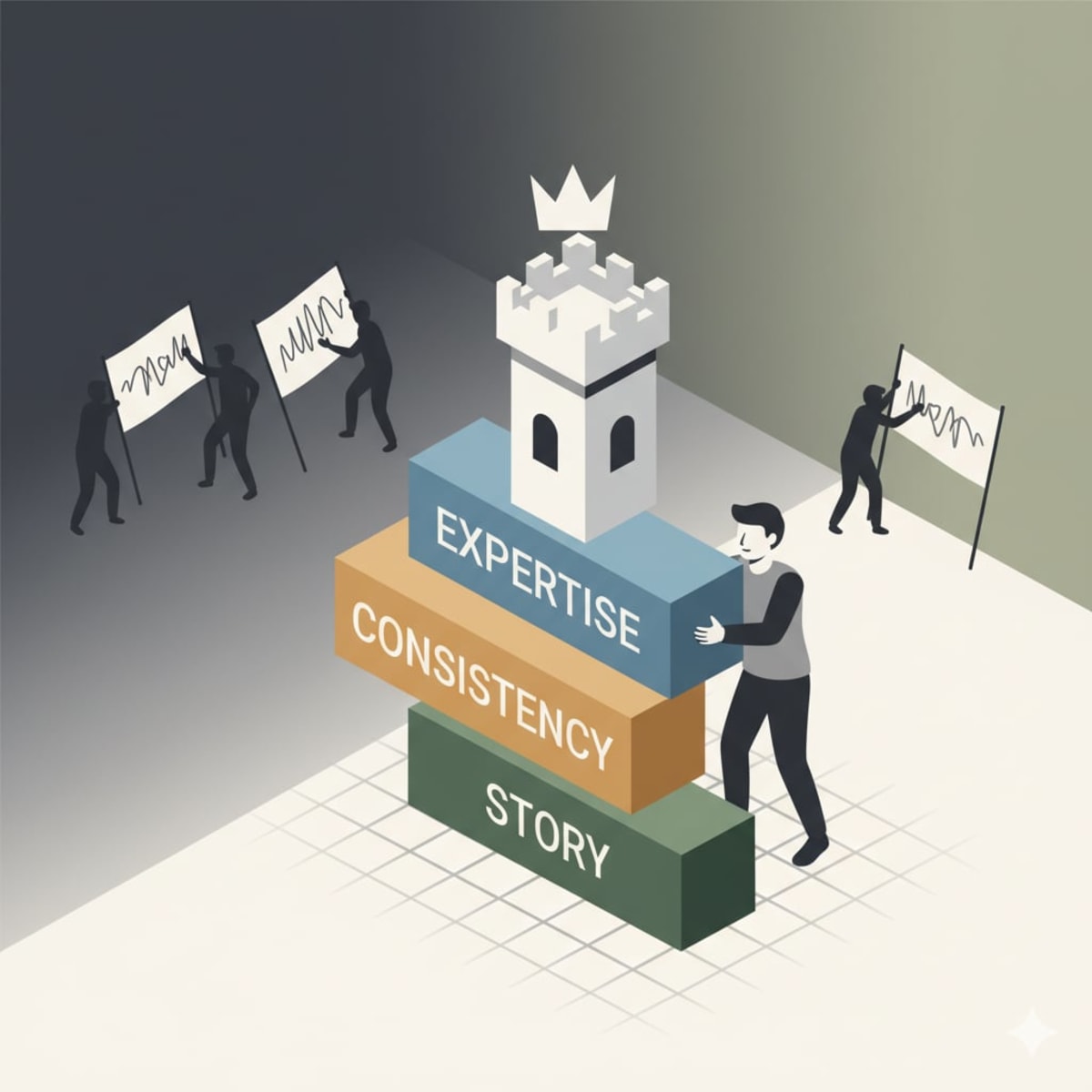
The Brand Equation Framework
After studying hundreds of successful service businesses, I've found they all follow the same formula:
Brand = (Expertise × Consistency × Story) ^ Time
Let me show you how this works with real businesses crushing it right now.
Expertise in Action: The Pool Guy Who Only Does Green-to-Clean
Tom in Boca Raton noticed that 30% of his pool service calls were disasters: pools that had turned green, full of algae, basically swamps. Other pool companies hated these jobs. Too much work, upset customers, chemicals everywhere.
Tom went all in. Now he ONLY does green-to-clean transformations. His entire business is pools that other companies won't touch. He documents every transformation with before/after videos. He guarantees crystal clear in 48 hours or it's free.
By becoming the expert in one specific problem, Tom charges $1,200 for what used to be a $300 job. His closing rate? 94%.
Consistency in Action: The Plumber With the Timer
Sarah runs "45-Minute Plumbing" in Denver. Every service call is 45 minutes or less, or it's free. Not the drive time, the actual fix. If she can't fix it in 45 minutes, she'll schedule a bigger job, but that first call? Always 45 minutes.
This forced Sarah to get incredibly good at diagnostics. Her team practices common repairs until they can do them blindfolded. They stock trucks with exactly what they need for 95% of calls.
Customers know exactly what they're getting. AI assistants love the clarity. Sarah's team does 12 calls per day versus the industry average of 6.
Story in Action: The Contractor for Anxious Homeowners
Marcus in Atlanta noticed that his best customers weren't asking about price, they were asking about process. "How disruptive will this be?" "What if something goes wrong?" "How do I know you won't disappear?"
So Marcus built his entire brand around anxiety reduction. Daily photo updates. A project portal showing exactly what's happening. A dedicated project phone that always gets answered. He calls his company "No Surprises Remodeling."
His marketing? Stories from anxious customers who were dreading renovation but found peace of mind. Every review mentions how Marcus made the process "actually enjoyable."
Marcus charges 20% above market and customers specifically seek him out when they're nervous about a project.
Finding Your Brand DNA
Your brand isn't something you create from scratch. It's already there: in how customers talk about you, in what you do differently without thinking about it, in the problems you solve that others ignore.
Here's how to find it. Ask yourself:
- What do customers thank you for that has nothing to do with your actual service?
- What do you do that makes competitors think you're crazy?
- If you could only tell customers ONE thing, what would it be?
- What problem do you solve that customers don't know they have?
- What would customers miss most if you disappeared tomorrow?
Let me show you how this works:
A real estate agent in Phoenix realized customers thanked her for being honest about which houses NOT to buy. Competitors thought she was insane for talking clients out of sales. Her ONE thing: "The agent who tells you when to walk away." Now she only works with buyers who value honesty over speed. Average commission: $18K vs. $11K market average.
An electrician in Seattle found that customers were thanking him for...texting back quickly. Just responding within 10 minutes to say "Got your message, I'll call you by 3pm." His ONE thing: "The electrician who always responds in 10 minutes." He built his entire operation around rapid response. Result: 3x industry close rate.
How Brand Multiplies Everything Else
Here's where it gets interesting. Remember those posts about content marketing and AI visibility? Brand doesn't replace those, it multiplies them.
Clay Electric: From Invisible to Inevitable
Clay Electric in Tampa was doing everything "right": Google ads, Facebook posts, email marketing. Annual revenue: $500K, stagnant for three years.
Then they found their position: "The Electric Educators." Every job includes a free lesson on how to avoid the problem in the future. They create weekly videos answering real customer questions. Their website has 200+ articles about electrical safety.
The same Google ads that used to convert at 2% now convert at 8%, because people recognize them as "those electricians from the YouTube videos." Reviews went from "they fixed it" to "they taught me so much!" AI assistants recommend them specifically for complex problems because they have the most comprehensive content.
Revenue went from $500K to $2.1M in 18 months. Same market. Same services. Different position.
Precision Plumbing: The Compound Effect
Watch what happens when brand compounds over time:
Year 1: Precision Plumbing in Houston decides to own "on-time." Not "on-time-ish" but actually on-time. They start texting customers a photo of their plumber 30 minutes before arrival. If they're even 5 minutes late, the service is free. Competitors mock them. Revenue: $600K.
Year 2: Word spreads. "Use Precision, they actually show up when they say they will." Reviews all mention punctuality. They raise prices 15%. Nobody blinks. Revenue: $1.1M.
Year 3: AI assistants start recommending them specifically when users ask for "reliable" or "punctual" plumbers. They haven't bought an ad in six months. Revenue: $1.8M.
Year 4: They're THE plumbing company for property managers who need dependable service for tenants. They expand to Austin and Dallas using the same playbook. Revenue: $4.2M.
The brand compound effect: credibility builds on credibility until you become inevitable.
Why This Strategy Works Now More Than Ever
AI has changed the game in ways most service businesses don't understand yet. When someone asks ChatGPT for a recommendation, it's not randomly picking from a list. It's pattern-matching based on what it knows about each business.
Generic businesses all look the same to AI: "AC repair, 24/7 service, licensed." But a business with a clear brand position stands out. "The only HVAC company that specializes in historic homes" or "The contractor who guarantees daily photo updates."
Here's what's actually happening:
Generic positioning: AI says "Here are some options in your area"
Clear brand position: AI says "For your specific need, this company specializes in exactly that"
The businesses that establish clear positions now are teaching AI what they're known for. Once AI learns you're THE option for a specific thing, competitors can't catch up just by copying you. They'd need to build the same depth of proof.
The 90-Day Brand Blueprint
You can't build a brand overnight, but you can build the foundation faster than you think. Here's how three real businesses did it:
Days 1-30: Discovery
What "All-Pro Painting" in Orlando did:
Surveyed their 10 best customers: "Why did you choose us?" Found the pattern: Customers kept mentioning they cleaned up perfectly Discovered their competitors left paint chips, drops, tape residue everywhere Their position emerged: "The painters who leave your home cleaner than they found it"
Days 31-60: Definition
What they built:
One-line promise: "Spotless painting, we leave your home cleaner than we found it" Created their "Clean Guarantee": before photos of every room, after photos showing zero trace Built a 21-point cleanup checklist they follow religiously Trained their team that cleanup was as important as painting
Days 61-90: Deployment
What they changed:
- Every quote includes the Clean Guarantee
- Website leads with "Spotless Painting" and cleanup photos
- Created content showing their cleanup process
- Reviews started naturally mentioning the incredible cleanup
Result: Close rate went from 22% to 41%. Average ticket increased 25%. Why? They stopped competing on price and started owning a position.
The Businesses That Get This Are Already Moving
While most service businesses are fighting over Google ad positions, a small group has figured out the game has changed. They're not trying to be better, they're becoming the only.
Rodriguez Tree Service in Miami only does emergency storm damage. That's it. No trimming, no maintenance. When a tree falls on your house, they're the specialists everyone calls. They charge 2x market rate and customers are grateful.
Sophie the Realtor in Fort Lauderdale only works with divorced women navigating property division. She partners with divorce attorneys, understands the emotional complexity, and never has to prospect. Her average commission is 40% above market.
TechHelp Senior Services in Pompano Beach only helps people over 65 with technology. They charge $150/hour to set up iPhones and explain Facebook. Their customers would pay double.
These businesses understand something fundamental: In a world where everyone can buy the same ads and use the same AI tools, the only sustainable advantage is owning a position in your customer's mind.
The Strategic Questions That Matter
The fastest-growing service businesses aren't asking "How can we do more marketing?" They're asking better questions:
What position could we own that nobody else wants? Sometimes the best positions are the ones competitors think are "too small." The plumber who only does garbage disposals. The lawyer who only does speeding tickets. The accountant who only works with food trucks. These "limitations" become your superpower.
What do we already do that we should make our entire identity? Look at what customers already thank you for. What competitors think is excessive. What you do naturally that others force. That's usually your position hiding in plain sight.
How can we make our position impossible to copy? It's not about being first, it's about being so associated with something that copying you looks desperate. When you've published 100 videos about historic home renovation, a competitor can't just claim that space.
What would we have to stop doing to be remarkable at one thing? This is the hard one. Brand requires sacrifice. You can't be the premium option AND the budget option. The specialist AND the generalist. The fast one AND the thorough one. Pick your position and commit completely.
Your Next 30 Days
Here's what separates businesses that talk about brand from those that build one: action. Not perfection, just movement in a clear direction.
Start where you are. Survey your best customers this week, actually call them and ask why they chose you. Look for patterns in your reviews. Notice what you do that others don't. Find that one thing you could own completely.
Then pick your position and test it for 30 days. Change your Google Business Profile description. Update your email signature. Answer every "what do you do?" with your position, not your category.
Watch what happens when you stop trying to be everything to everyone and start being everything to someone. Watch how marketing becomes easier when you know exactly who you're talking to. Watch how price becomes less important when you're the only one who does what you do.
The businesses that figure this out don't just survive. They become institutions in their communities. They become categories of one. They become irreplaceable.
And that's exactly what your customers are waiting for: not another option, but the obvious choice.